


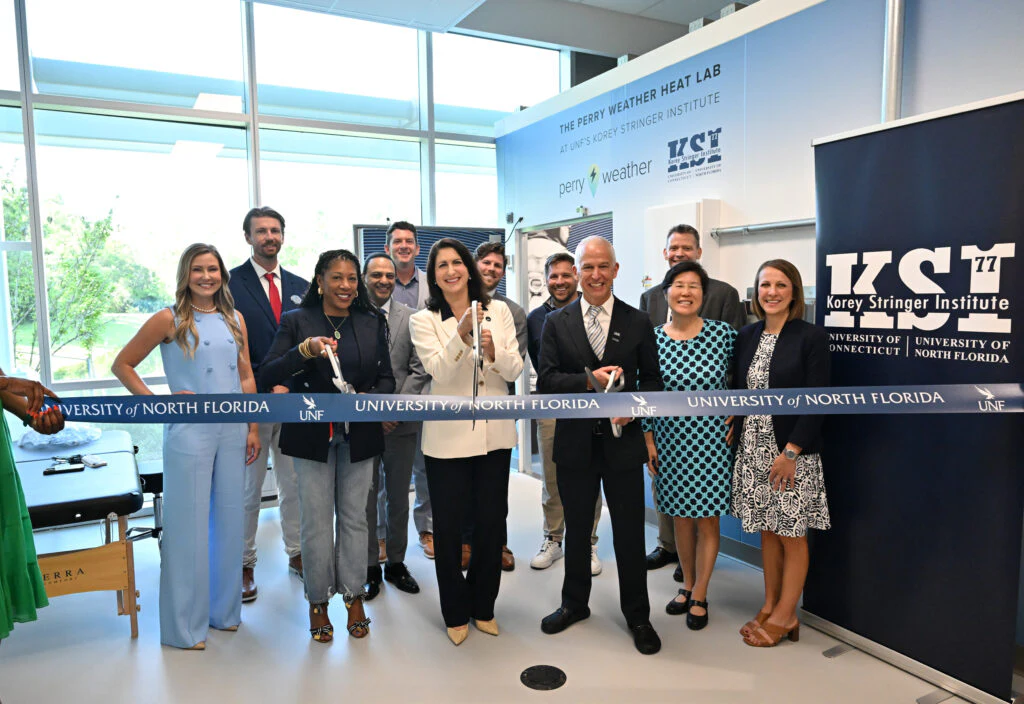
The Perry Weather Heat Lab at the University of North Florida is officially open, marking the first satellite location of the Korey Stringer Institute (KSI), the nation’s leading authority on exertional heat illness.
What’s Happening Inside the Heat Lab
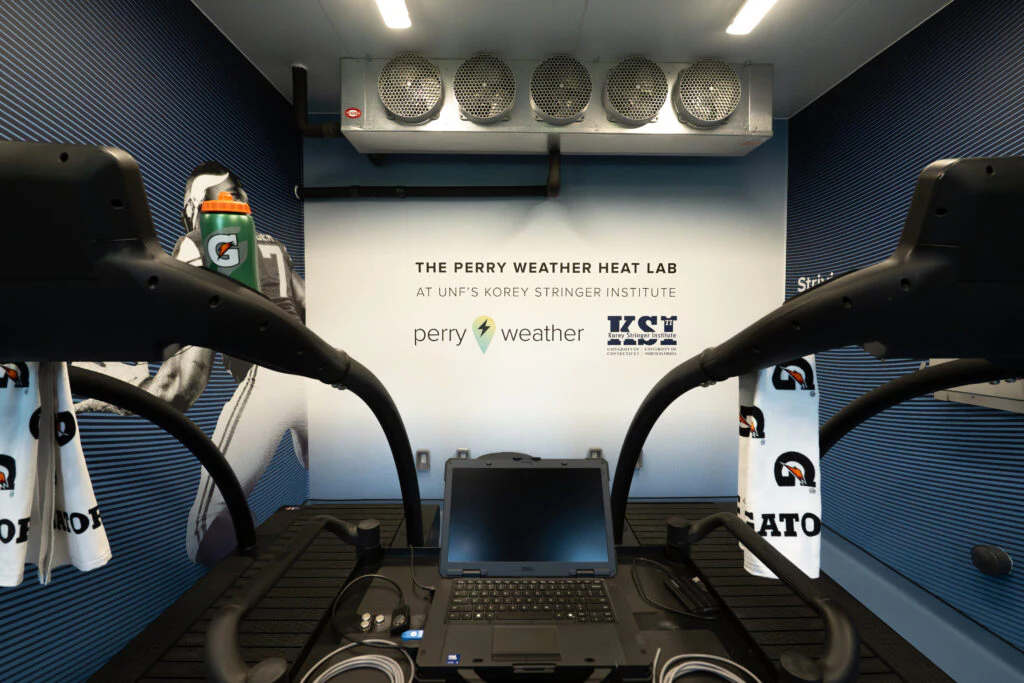
The state-of-the-art heat lab is a controlled environment research facility capable of simulating extreme heat conditions, measuring the body’s physiological response, and turning those findings into protocols that protect vulnerable people and teams before heat-related incidents occur.
The research will span athletes, warfighters, and outdoor workers, covering the full range of environments where heat is becoming increasingly dangerous.
Expanding the Science to the Outdoor Workforce
Of those populations, the outdoor workforce represents the biggest research gap in heat safety today. Studies have long focused on young and often healthy athletes while the effects of heat on older construction crews, manufacturing workers, grounds maintenance teams, and laborers with preexisting conditions have remained unclear.
They work not just for a few hours at practice, but through 12 hour shifts in conditions that don’t let up.
Future research from the Perry Weather Heat Lab will replicate occupational conditions like heat and workload and study the physiological effects. In doing so they aim to develop evidence-based safety standards & heat illness mitigation strategies built specifically for them.
“Heat-related illness is one of the most preventable risks facing athletes and outdoor workers today. Perry Weather was founded on the belief that better data and better decisions can save lives, and this lab is the next step in that work.” — Colin Perry, CEO and Founder, Perry Weather
Heat Safety Is at an Inflection Point
More than ever a shift is occurring across every environment where people work and compete in the heat. Driven by better science, growing regulatory pressure, and a hard-won recognition that heat illness can be eliminated, not just managed.
In a Perry Weather survey of 250 construction leaders, 79% reported at least one heat-related incident in the past 12 months. The average site sees 5 to 10 incidents per year. Each costing between $5,000 and $10,000 on the low end if the employee is treated properly.
In some cases, settlements for heat injuries have cost up to $39.5MM when the proper response measures weren’t implemented.
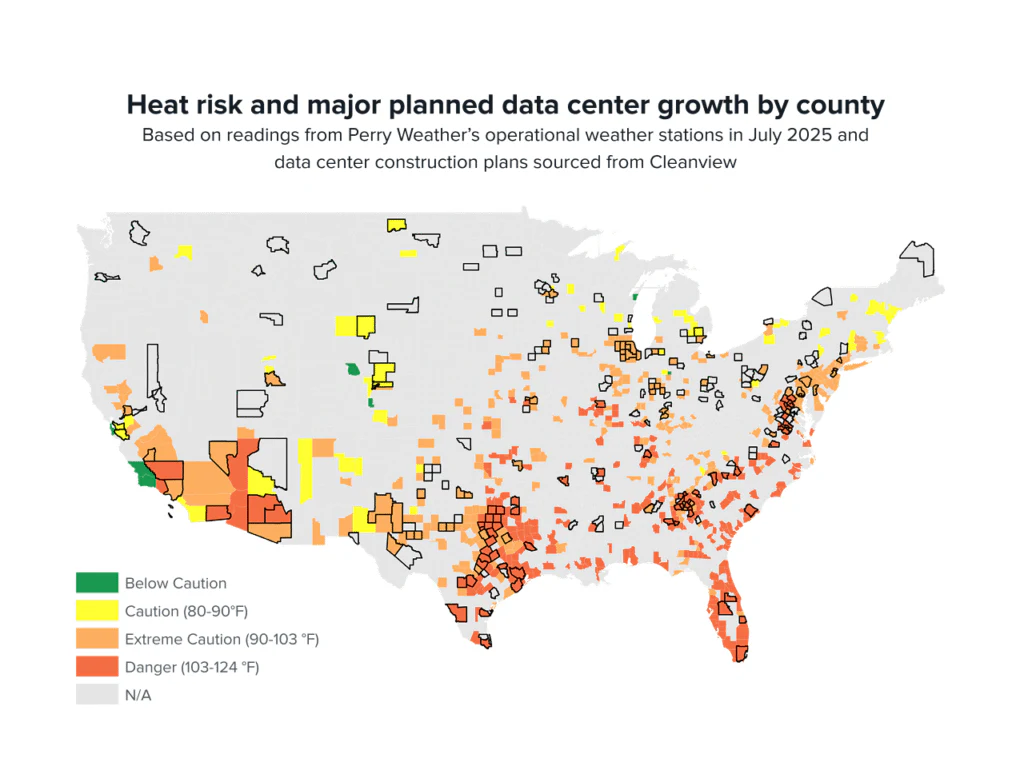
Meanwhile, the scale of outdoor work is growing fast. US data center capacity is projected to more than double by 2030, with single campuses now requiring up to 5,000 construction workers.
Many of the counties with the highest concentration of data center construction projects are building in Virginia, Texas, Arizona, and the Southeast, some of the hottest regions in the country.
Our 2026 New Climate of Construction Report breaks down the counties most affected by this intersection of high heat and historically high construction capacity.
2026 Report
The New Climate of Construction
America’s construction boom is landing in its hottest counties. See where heat risk is concentrating — and the four-part framework for keeping crews safe without slowing work.
Furthermore, the policies & heat recommendations in place to protect these workers are largely out-of-date and rely on heat index rather than the more accurate Wet Bulb Globe Temperature (WBGT.)
Meanwhile, state high school athletic associations including the California Interscholastic Federation and Texas’s UIL taking a modern approach to heat safety and are now mandating WBGT monitoring for outdoor activities. Rather than ask whether to take heat safety seriously, organizations are searching for the infrastructure to make that safety sustainable.
WBGT and Why It’s the Standard for Heat Safety
Most industries are still making heat safety decisions based on heat index. However, that metric measures perceived temperature using only air temperature and humidity, calculated in the shade. It’s a starting point. It’s not enough.
But WBGT (Wet Bulb Globe Temperature) is the gold standard. It accounts for temperature, humidity, wind, and solar radiation together. Combined, it creates a complete picture of what the body is actually experiencing in real outdoor conditions.
WBGT & Heat Index Compared
| Variable | WBGT | Heat Index |
|---|---|---|
| Air temperature | ✓ Yes | ✓ Yes |
| Relative humidity | ✓ Yes | ✓ Yes |
| Wind speed | ✓ Yes | ✗ No |
| Solar radiation (sunlight) | ✓ Yes | ✗ No |
| Surface / radiant heat | ✓ Yes | ✗ No |
| Cloud cover | ✓ Yes | ✗ No |
| Sun angle / time of day | ✓ Yes | ✗ No |
A 95°F day with high humidity and no wind carries a fundamentally different risk than a 95°F day with a breeze. WBGT captures that and more accurately measures the affects the heat has on the human body.
Today, Perry Weather operates the world’s largest connected network of on-site WBGT monitoring stations. More than 3,100 stations across schools, worksites, campuses, and facilities can be found nationwide. And that same instrumentation serves as the research grade foundation inside the Perry Weather Heat Lab. A direct line between science and the field.
What Zero Heat-related Deaths Looks Like
Good tools and good science require good partners. That’s why we’ve partnered with the Korey Stringer Institute.
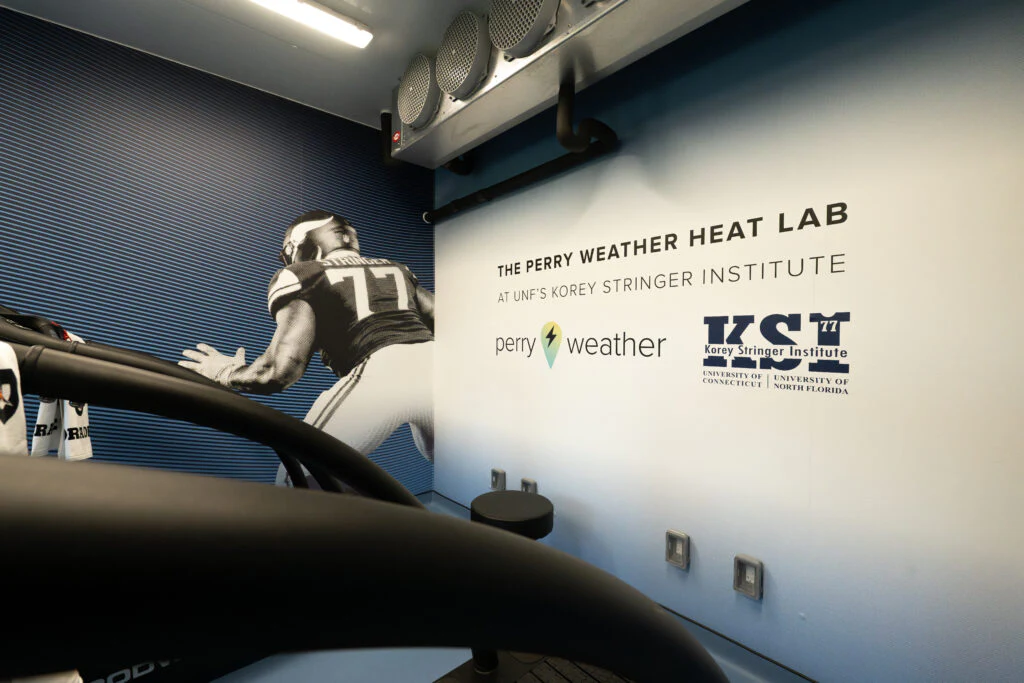
KSI was founded in 2010 in memory of Minnesota Vikings Pro Bowl lineman Korey Stringer, who died of exertional heat stroke at training camp at age 27. In the 15 years since, the institute has influenced more than 460 environmental safety standards, revised protocols at over 300 high schools.
For Perry Weather and KSI, the bar is set at zero preventable heat-related deaths. Anything less accepts outcomes that don’t have to happen.
“This expansion to the University of North Florida is a defining moment for the Korey Stringer Institute and for the future of heat safety. Together, we are ensuring that no one suffers or dies from a preventable heat-related illness.” — Douglas Casa, CEO, Korey Stringer Institute
Positioned in Florida, where heat conditions are among the most extreme in the country, the Perry Weather Heat Lab is where that shared mission will produce better research, better tools, and better outcomes for everyone who works or competes in the heat. Perry Weather is proud to partner with KSI and UNF to make that change.
Heat safety starts with the right measurement. Explore how to : What is WBGT and how do you calculate it? · WBGT Calculator · Construction Heat Stress Report


