


Perry Weather is not affiliated with or sponsored by the University Interscholastic League (UIL). All references to UIL are for editorial and informational purposes only.
Starting with the 2026-2027 school year, monitoring Wet Bulb Globe Temperature is expected to be the required standard for every UIL Texas school that runs outdoor athletics or marching band.
On June 10, UIL Legislative Council approved the shift in policy: moving WBGT monitoring from a recommendation to a requirement. Since 2023, Texas schools have been strongly encouraged to monitor Wet Bulb Globe Temperature during outdoor practices.
When The Requirement Will Go Into Effect
If approved by Texas Commissioner of Education, the requirement will take effect August 1, 2026, ahead of fall practices, and applies to every UIL member school that conducts outdoor athletics or marching band activities.
Under the new standard, schools must use WBGT to monitor practice and workout conditions and adjust activity based on the readings. This covers hydration, rest breaks, activity modifications, and acclimatization that follows UIL’s heat protocol chart. UIL has noted the change may carry a cost for schools that need to add monitoring equipment or software.
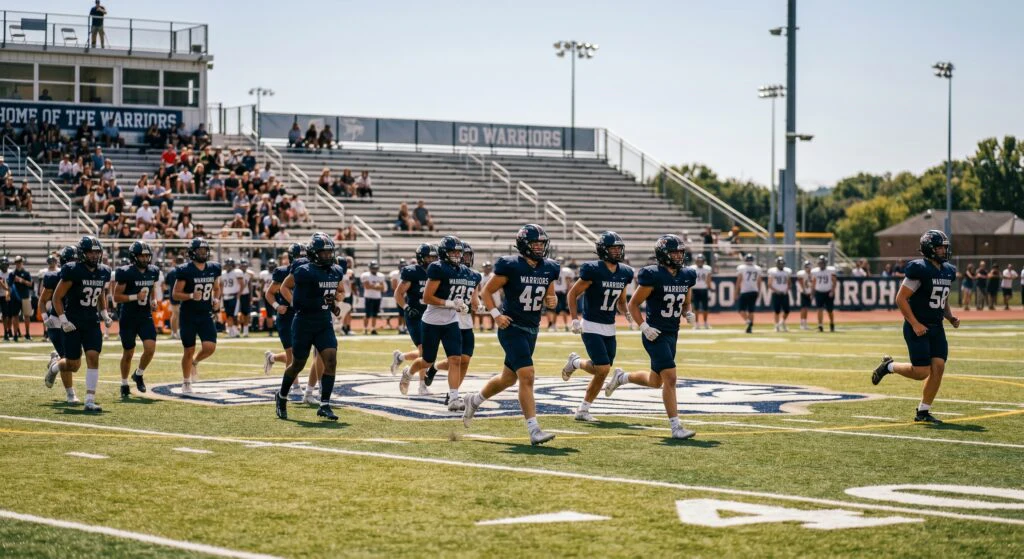
How WBGT Monitoring Became A Required Standard in Texas
Following “two successful years of recommended implementation,” the UIL Medical Advisory Committee – a panel of medical professionals that advises UIL on health and safety – unanimously called for WBGT monitoring to become the requirement at its April 2026 meeting. The Standing Committee on Policy reviewed the proposal and advanced it to the full Legislative Council, which passed the measure on June 10, 2026.
Like all UIL rule changes, the new standard requires final approval from the Texas Commissioner of Education, with an effective date of August 1, 2026.
The new standard rests on WBGT because it is found to capture more than just air temperature does. A Wet Bulb Globe Temperature reading combines temperature, humidity, wind speed, and solar radiation into a single number that reflects the conditions athletes actually face outdoors so staff can get a more complete measure of heat stress than air temperature or heat index alone.
See How Your Region’s Practice Times Were Affected
View an interactive report showing real WBGT data from over 700 weather stations across the state of Texas.
Timeline for Schools to Implement the Requirements
Turnaround time since announcement is tight, schools have roughly six-weeks to prepare and acquire WBGT monitoring equipment. Most Texas athletic programs start with football practice in August, with some regions averaging a nearly 90 degree peak WBGT reading according to Perry Weather historical data.
In its original recommendation, the committee pointed to the rising frequency and severity of extreme heat across Texas, particularly at the start of fall sports seasons. A statewide blanket standard, members argued, would replace inconsistent school-by-school practices with one consistent standard and close the gaps left by voluntary guidance.
Complete
The UIL approved Wet Bulb Globe Temperature (WBGT) as the recommended measurement for monitoring heat stress during outdoor activities, replacing the traditional Heat Index with a standard that accounts for temperature, humidity, wind speed, and solar radiation.
Complete
The UIL Medical Advisory Committee voted unanimously to advance WBGT from a recommendation to a formal requirement as a pivotal step in the rule-making process for all Texas member schools.
Complete
The UIL Legislative Council voted to make WBGT monitoring a binding requirement for all member schools. The rule now awaits final approval from the Texas Commissioner of Education.
Upcoming
As the new school year begins, UIL member schools start standard compliance with WBGT-based heat protocols — taking effect as soon as summer practices kick off for marching band and fall sports like football, cross country, and tennis.
What are the WBGT Guidelines for Texas
WBGT starts with temperature, then factors in humidity, wind speed, and solar radiation to produce a single number that reflects how the body actually experiences heat. A 95-degree day with low humidity and a breeze is meaningfully different from a still, humid 95-degree day; even though a thermometer reads them the same.
UIL’s heat protocols are built on WBGT Activity Guidelines adapted from the American College of Sports Medicine, and the thresholds vary by region.
UIL divides Texas into two geographic zones on its WBGT map:
- Class 2 schools: Activity modifications begin at a WBGT of 79.7°F
- Class 3 schools: Activity modifications begin at a WBGT of 82°F
Your school’s classification determines which threshold applies to you, and the WBGT Activity Guidelines chart outlines the specific modifications required at each level. These include adjustments to work-to-rest ratios, hydration breaks, equipment worn, and practice duration. At the highest levels, outdoor activity must stop entirely.
Source: UIL Heat Stress & Athletic Participation Recommended Plan — based on American College of Sports Medicine guidelines.
Beyond the threshold numbers, UIL specifies how monitoring must be conducted:
- WBGT must be read within 15 minutes before the start of practice
- If using an on-site instrument, it must be set up 30 minutes before practice begins
- Readings must be taken every 30 minutes throughout the practice window
- The same person should take all readings during a given practice for consistency
- Schools should document and keep on file the WBGT readings associated with each outdoor practice
For more guidance on UIL WBGT state read our Texas state weather policies page here.
What Compliance Actually Looks Like
Meeting this operationally can require more involvement than some schools currently have in place. Common options are:
Handheld WBGT Monitors
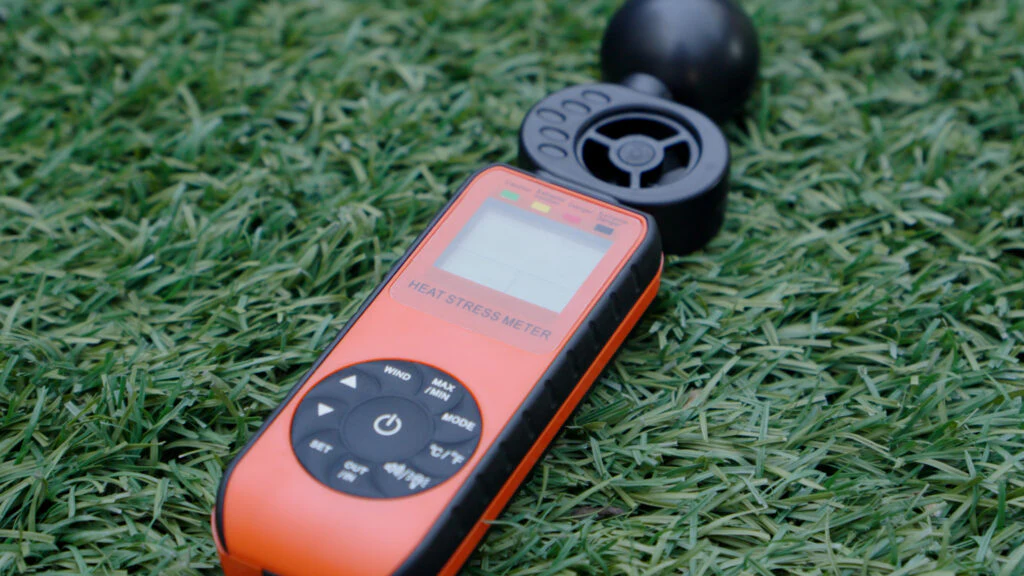
A handheld WBGT meter requires someone to set it up 30 minutes before practice, take a reading 15 minutes before the start, then read it again every 30 minutes through the full session for every outdoor program, every day. Football. Cross country. Soccer. Band. Each reading depends on the right person being there, on time, and remembering, which can be cumbersome.
Online Public WBGT Data Sources
An internet-based tool like the UNC WBGT forecasting resource UIL references takes the manual labor out, but it gives you a forecast instead of a measurement. Forecast WBGT comes from regional weather models; a genuinely useful planning tool, though it reflects the wider area rather than the field your athletes are on.
A practice field ringed by bleachers and artificial turf can run hotter than the regional number, and conditions shift through the afternoon. For real-time decisions, you need the WBGT at your field, in that moment.

Considerations when choosing how you will monitor WBGT
UIL’s language states that schools are encouraged to use either a scientifically approved on-site instrument or a scientifically proven internet-based application. Both are acceptable under current guidance. But as monitoring moves from recommendation to requirement, the standard for what counts as sufficient documentation will likely tighten. A printed forecast is easier to dispute than a timestamped, location-specific sensor reading.
There is also the liability factor. When a student experiences heat illness, the first question asked is whether the school was monitoring conditions and following protocols. Documentation matters. A manual log is better than nothing. An automated, time-stamped record is even better.
How Perry Weather Schools Are Already Meeting These Requirements
Perry Weather’s on-site weather stations measure WBGT directly at the field thanks to instruments installed at your facility. Temperature, humidity, wind speed, and solar radiation are all measured in real time and combined into a live WBGT reading that updates continuously.
When WBGT crosses a threshold, the system can trigger automated alerts to coaches, athletic trainers, and administrators. No manual reads. No relying on a single person to check a device every 30 minutes. And no question about whether the right protocol is in effect.
Perry Weather records a timestamped WBGT reading for every outdoor session automatically. That gives you the documentation UIL’s record-keeping guidance calls for, and a record that holds up if a practice is ever called into question. Watch the video to see how it works in two minutes or less.
The required standard takes effect August 1, 2026, and fall practices open right around it. That makes the summer the ultimate window to get a system in place. Schools that want to be ready in August are the ones setting it up now.


