

Tap Use My Location to get the current WBGT near you, enter your ZIP code, or type in your own conditions from on-site readings to manually calculate your WBGT.
What is the WBGT right now?
Outdoor WBGT Calculator
Use your location to load current conditions, or enter your own. WBGT updates as you type.
Location, time & pressure
Location and time set the sun angle. Leave pressure blank for sea-level standard.
The sun is down at this time and place, so sun and shade readings are the same.
Estimated with the Liljegren et al. (2008) heat-transfer model, the same method behind OSHA's outdoor WBGT calculator. Estimates from weather data can differ from conditions at your site by several degrees. Use on-site WBGT measurements for safety decisions, and check thresholds against your state association's or organization's own heat policy.
How this calculator works
The calculator loads the latest weather observations from the nearest National Weather Service station: air temperature, humidity, wind, and cloud cover from your location. It estimates your location’s WBGT using the Liljegren model, the same method OSHA uses.
Some quick WBGT estimates only use temperature and humidity, the same two inputs as the heat index, and assume a fixed amount of sun and wind. That misses what makes WBGT different from other heat stress measurements – how much sun you’re in and how much wind is cooling you. This calculator uses the Liljegren model, which accounts for sun angle, cloud cover, and wind, so a cloudy, breezy afternoon reads lower than a clear, calm one.
“You need to account for solar radiation and wind speed. The wind is going to affect how much you cool off, and the solar radiation is going to cause your body to absorb a certain amount of heat.” — David Martin, PhD, Director of Science, Perry Weather
WBGT combines three temperatures using a weighted formula:
Outdoor Formula — Direct Sunlight
WBGT = 0.7 × Tnwb + 0.2 × Tg + 0.1 × Tdb
Tnwb · 70%
Natural wet bulb — evaporative cooling capacity
Tg · 20%
Globe temperature — radiant heat from sun and surfaces
Tdb · 10%
Dry bulb — ambient air temperature in shade
The calculator shows two results: WBGT in the sun, for full exposure under the sky conditions you set, and WBGT in the shade. For a full breakdown of what each component captures and why the weights work the way they do, see our “What is WBGT? guide.
What your WBGT means for your location
Athletics WBGT categories
Many state high school associations use regional WBGT categories developed by Grundstein et al. (2015). Each part of the country is in one of three categories based on its climate. Hotter regions have higher thresholds because athletes there are more used to the heat.
OSHA heat categories
For workers, OSHA’s heat guidance sets WBGT limits by how hard someone is working and whether they’re used to the heat. The harder the work, the lower the limit, and workers new to the heat (less than 1–2 weeks on the job) have lower limits than acclimatized workers. The limits are adapted from NIOSH’s 2016 heat criteria. To check a reading, choose your workload in the calculator’s Compare to menu.
How accurate are WBGT estimates?
An estimate from weather data is a starting point, not a measurement. The nearest weather station may be miles away, and it can’t see the turf, asphalt, wind breaks, or shade at your site. In an Arizona study (Guyer et al., 2021), WBGT measured on site averaged about 2.5°C (4.5°F) higher than estimates from nearby weather stations run through the same Liljegren model this calculator uses. In June, every venue spent 4 to 6 hours a day in the “discretion” category, which the station-based estimates never reached.
A reading that runs high isn’t automatically the safer one.
“I’m always on the side of being more cautious. But we also don’t want to be canceling practice when it’s not necessary. If athletes aren’t acclimating to the weather and then they have to go out in the heat, that actually makes it even more dangerous.” — David Martin, PhD, Director of Science, Perry Weather
Indoor WBGT calculation
Indoors, or anywhere without direct sun, OSHA uses WBGT = 0.7 × natural wet bulb + 0.3 × globe temperature. This calculator’s shade result is a fair estimate for indoor spaces without heat-producing equipment. Near ovens, furnaces, or kilns, radiant heat pushes WBGT higher, and only a wet bulb globe sensor at the work location will catch it.
To find your state’s OSHA heat regulations, click here.
Checking WBGT on your phone
This WBGT calculator works in any phone browser, so there’s no app to install. Tap Use My Location at the field or job site to load conditions from the nearest weather station, then adjust anything that doesn’t match where you’re standing.
Common WBGT calculation mistakes
| 1 |
Mixing unitsAll inputs must be in the same unit — Celsius or Fahrenheit throughout. Mixing the two produces nonsense results. |
| 2 |
Wrong formula for the environmentOutdoor formula in shade, or dropping the globe term near indoor radiant heat sources, both misrepresent actual heat load. |
| 3 |
Wet wick drying outA dry wick reads near dry bulb, artificially lowering WBGT. Keep it saturated with clean distilled water. |
| 4 |
Globe not stabilizedReading before 15–20 minutes of equilibration produces an unreliable Tg. |
| 5 |
Dry bulb in partial sunMust be in genuine shade. Even partial sun pulls the reading up and skews WBGT. |
| 6 |
Sensor not at the work locationA globe in a shaded hallway near a hot line reads lower than one where workers stand. OSHA expects measurements at the work location. |
| 7 |
Reading during a transitionCloud cover changes, wind shifts, and furnace cycles all disturb readings until conditions settle. |
| 8 |
Trusting a single handheld spikeSmall-globe units respond quickly but spike easily. Average across several minutes for a reliable reading. |
| 9 |
No documentationA correct reading without a timestamped log doesn’t satisfy OSHA recordkeeping expectations under the revised NEP. |
Most errors come from inputs and setup, not the formula.
When to use on-site monitoring
If you make go/no-go decisions for athletes or crews, you need readings from where they are, logged for your records. Where the sensor sits matters as much as the sensor itself.
“Wherever you are installing this device, it needs to share the same environmental conditions as the area in which you are monitoring.” — David Martin, PhD, Director of Science, Perry Weather
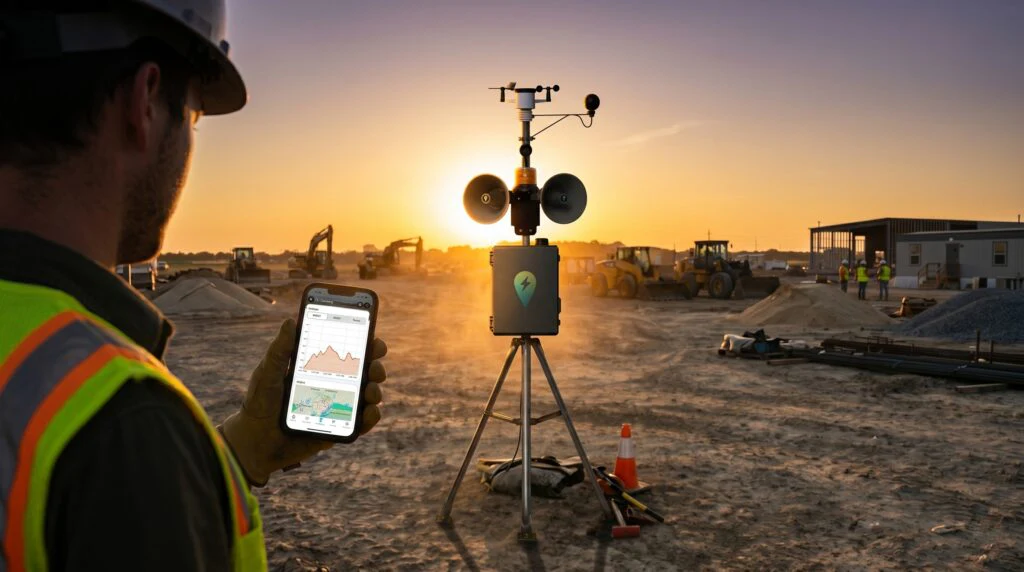
If the field is in full sun, the sensor shouldn’t be in the shade. A field sheltered from the wind can read differently from a rooftop next door. A Perry Weather station measures WBGT on site, logs every reading automatically, and alerts your team when conditions cross your policy thresholds.
The bottom line on WBGT calculation
Getting a WBGT reading isn’t the hard part. Getting one that’s accurate, documented, and easy to implement into your workflow is. Perry Weather handles all of it.
On-site monitoring
A permanent station at your location measures WBGT from actual conditions — your sun exposure, your wind, your radiant heat sources — not from a weather station miles away. Readings update every 5 minutes, continuously, without manual intervention.
Automatic recording
Every reading is timestamped and stored automatically. No manual logs, no reconstructed records, no gaps. When an OSHA inspector asks what conditions were at 1:45 PM last Tuesday, the data is already there.
Exportable reports
Historical WBGT data is exportable on demand — by date range, by threshold, by location. Useful for OSHA audits, workers’ comp reviews, incident documentation, and demonstrating ongoing compliance before anyone asks. Watch the video to see how it works.
Policy-based alerts
Set your own thresholds — by WBGT zone or heat index level — and Perry Weather alerts your team automatically the moment conditions cross them. The right people get notified, with the right instructions, at the right time. No one has to be watching a dashboard.
How is WBGT calculated?
Outdoors, WBGT = 0.7 × natural wet bulb + 0.2 × globe temperature + 0.1 × air temperature. Natural wet bulb carries the most weight because sweat evaporating from the skin is the body’s main way to cool off. For a full walkthrough, see What Is WBGT?
Is WBGT the same as wet bulb temperature?
No. Wet bulb temperature reflects only heat and humidity. WBGT adds the effects of sun and wind through the globe and natural wet bulb readings, so in full sun it usually reads higher.
Is WBGT the same as heat index?
No. The heat index uses temperature and humidity and assumes you’re in the shade. WBGT accounts for sun and wind, so it’s a better fit for outdoor work and practice.
Why can WBGT stay moderate on a very hot, dry day?
Low humidity lets sweat evaporate quickly, which keeps natural wet bulb, the biggest part of WBGT, lower. On a visit to New Mexico, David Martin, Perry Weather’s Director of Science, saw air temperatures of 106°F while WBGT only moved from 88°F to 89°F.
How do I check WBGT right now?
Use the calculator above with your location for an estimate. For readings you can act on and document, use an on-site WBGT sensor.


