


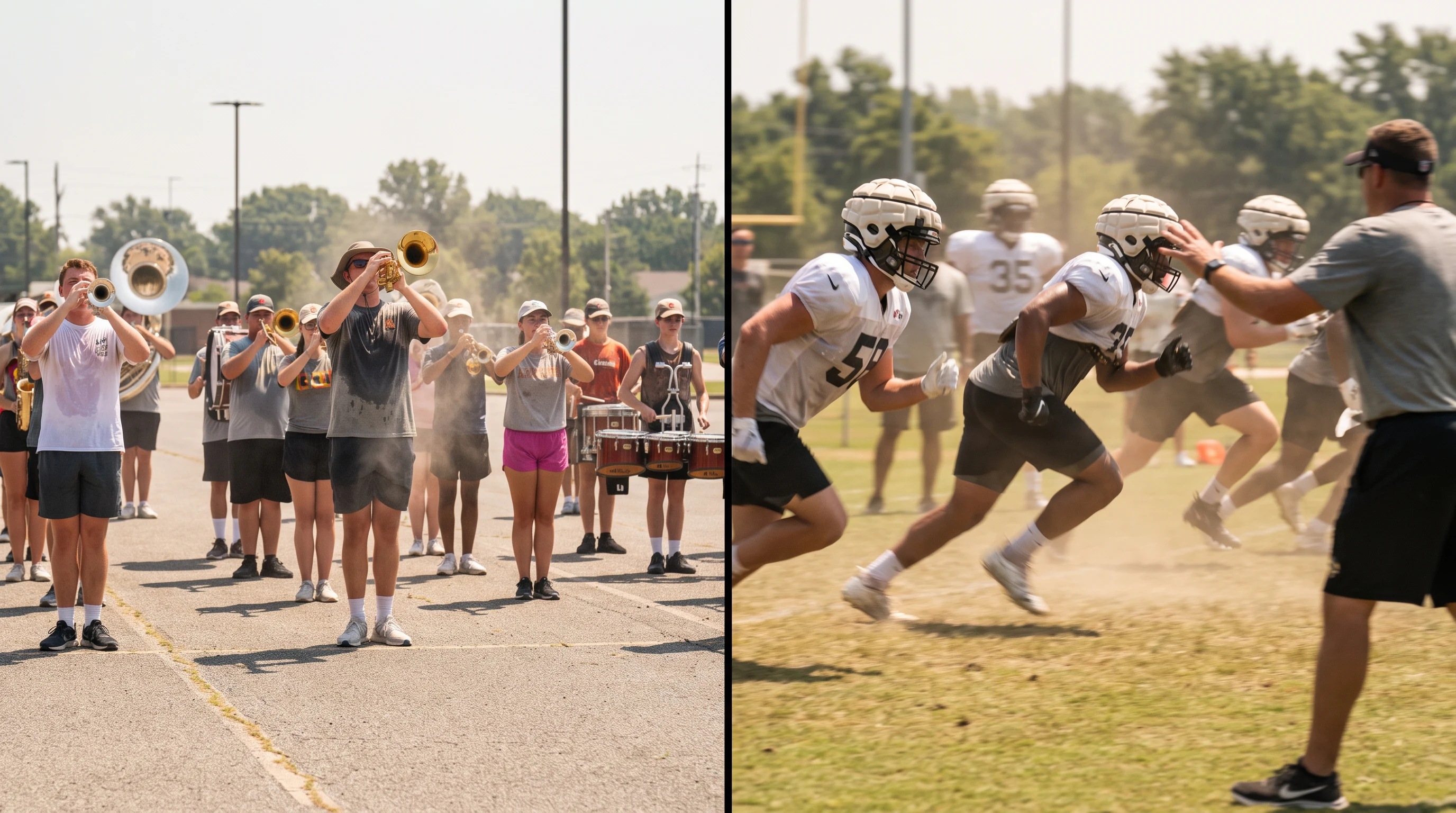
Beginning with the 2026-27 school year, the use of wet bulb globe temperature (WBGT) to guide outdoor athletic and marching band activity is no longer a UIL recommendation. It is a required standard. The mandated protocols went into effect August 1, 2026, following two years of voluntary use and a recommendation from the UIL Medical Advisory Committee to the Legislative Council.
We brought together Dr. Robert Huggins of the Korey Stringer Institute, Scott Galloway of UT Southwestern, and Dr. David Martin of Perry Weather to walk through what the mandate actually asks of schools. Here is what they covered.
The History of Heat Illness in High School Athletics
Between 1980 and 2009, there were 159 heat stroke fatalities among youth, high school, and collegiate football players. In a sub-sample of 61 of those deaths, the pattern is almost uniform: 100 percent occurred during conditioning drills, 97 percent of the victims were linemen, and 37 percent were being conditioned as punishment.
Dr. Huggins explained why linemen carry so much of that risk:
“Linemen are fighting an uphill battle. They have large body mass, their convective airflow is completely hindered most of the time, especially when they’re wearing full equipment. On top of being asked to push another 300-and-something-pound individual across from them, that generates a lot more metabolic heat, and puts them at greater risk than your more cardiovascularly trained, skill-position players.”
– Dr. Robert Huggins, Occupational Safety & Athlete Performance, Korey Stringer Institute
Football is not the only exposure. As a reminder of how differently heat stroke presents depending on an athlete’s size and can be seen across a variety of sports like cross country, soccer, and even ice hockey carry real heat risk. This past Boston Marathon, the air temperature was only 50 degrees, and there were still nine heat strokes.
What is Wet Bulb Globe Temperature?
The three measurements schools encounter are not variations on each other. They count different things.
| Measurement | What it accounts for | Why it falls short for athletics |
|---|---|---|
|
Ambient temperature
|
Air temperature only. | Ignores humidity, sun, and wind. Two days at the same reading can carry very different risk. |
|
Heat index
|
Air temperature and humidity. | Built for a person walking in the shade in long clothing. Ignores solar load and wind, and athletes are not in the shade. |
|
Wet bulb globe temperature
Athletics standard
|
Air temperature, humidity, wind speed, and solar radiation. | It doesn’t. Measured on site, where the athletes actually are, which is why it’s the standard used by the military, OSHA guidance, and FHSAA. |
WBGT is not new. It came out of the U.S. military after roughly 600 heat illnesses at Parris Island over one summer in the early 1950s.
Two researchers, Yaglou and Minard, built a flag-based system around the measurement, and heat illness rates dropped sharply once boot camps adopted it. The same four-factor calculation is now the basis for the UIL’s mandate: air temperature, humidity, wind speed, and solar radiation, weighted together into a single number that reflects how well an athlete can actually cool down through sweat evaporation.
Why Your WBGT Reading Looks Lower Than the Temperature
This is the most common point of confusion, and it’s worth settling before coaches ever see the chart. WBGT is its own scale, not a version of air temperature. Doing research in New Mexico, Dr. Martin recorded a 106-degree ambient reading at around 30 percent humidity while WBGT stayed in the high 80s.
“I think it’s a huge misnomer that a lot of people say, oh, 90-degree wet bulb globe temperature is the same as 90 ambient. It’s totally not the case. It could be in the hundreds in terms of ambient temperature, but the way the calculation works out, wet bulb globe temperature does not correlate well to ambient temperature. They’re two different measurements.”
– Dr. David Martin, Director of Science, Perry Weather
A coach who hears “no outdoor activity above 92” and pictures 92 degrees on a thermometer will assume conditions are worse, or better, than they actually are. Either mistake leads to the wrong call.
The 4 Key Tenets of Preventing Heat Stroke
Prevention, recognition, assessment, and treatment. Dr. Huggins walked through all four, and the through-line is speed.
Prevention rests on heat acclimatization, proper hydration, appropriate work-to-rest ratios, and environmental monitoring, which is exactly what the WBGT mandate is built around.
Recognition comes down to central nervous system dysfunction: confusion, irrational behavior, collapse, or altered consciousness. It doesn’t always look the same.
Assessment still relies on a rectal thermometer. There is no other valid field method for confirming exertional heat stroke, and Dr. Huggins was blunt about what happens without one:
“I’ve had people who’ve had to cool for 50 minutes, and I’ve had people who have cooled for less than 10. So you don’t know how long to cool, and you can over-cool or under-cool that athlete if you don’t have something to go by.”
– Dr. Robert Huggins, Occupational Safety & Athlete Performance, Korey Stringer Institute
Treatment means cooling first, aggressively, with cold water immersion, then transporting only once body temperature has reached a safe level. Dr. Huggins tied the standard directly to the person the Korey Stringer Institute is named for:
“Corey did not receive this, and he died, and we do what we do in his name, and the name of many others who have died since him. We continue to advocate for these things because we know that with all of these combined, you’re usually 100 percent effective in mitigating exertional heat stroke.”
– Dr. Robert Huggins, Occupational Safety & Athlete Performance, Korey Stringer Institute
Scott Galloway added a case that complicates the picture. His team followed protocol exactly, and it still was not the end of the story:
“We had a case here last year of a student-athlete who definitely had heat stroke. The athletic trainer, by the book, took rectal temperature, cooled the athlete, and transported, and we celebrated a successful save. And the young man ends up passing away due to some other underlying health risk factors that the athletic trainer and medical team weren’t aware of.”
– Scott Galloway, Manager of Sports Medicine, UT Southwestern
His point: know as much as possible about a student’s medical history going in, and make sure that information travels with the athlete after treatment, not just the temperature reading.
The UIL WBGT Zones
Texas uses two risk classes rather than one statewide chart. Class 2 covers a smaller region in the western part of the state, where students see less heat and humidity acclimatization; Class 3 covers the rest of the state. Both classes share the same five activity tiers, just at different thresholds.
Source: UIL Heat Stress & Athletic Participation Recommended Plan — based on American College of Sports Medicine guidelines.
Measurement Requirements
Once WBGT is reasonably expected to reach 79.7°F (Class 2) or 82.0°F (Class 3), monitoring is required, both outdoors and indoors in any facility that isn’t climate controlled.
30 minutes before Set up the on-site WBGT instrument so it has time to acclimate to conditions.
15 minutes before Take the first reading, either from the device or a qualifying app.
Every 30 minutes during Re-read throughout the entire practice or workout.
The UIL recommends the same person take every reading for consistency, that activity adjust immediately at each zone change, and that all readings be kept on file.
A roof does not exempt a facility. Dr. Huggins has seen indoor spaces that were worse than the field:
“I’ve been in wrestling rooms at universities in the South, and they were more oppressive than outside on the football field. If you’ve got basketball, wrestling, volleyball indoors, in a non-climate controlled facility, these guidelines apply to them as well. You’re taking the sun out of it, but you’re reducing airflow and potentially trapping humidity inside that structure.”
– Dr. Robert Huggins, Occupational Safety & Athlete Performance, Korey Stringer Institute
Hydration, Rest, and Cooling Zones
Hydration and Rest. Athletes have unrestricted access to water at all times. An athlete is never denied water. A rest break means unlimited hydration and full rest with no activity involved.
Cooling Zones. At or above the threshold, every emergency action plan must include an onsite rapid cooling zone using cold water immersion or an equivalent method, such as an immersion tub or an ice-and-water tarp using the TACO method. A trained responder should be on site to administer it.
Emergency Action Plans. Texas has required written, venue-specific emergency action plans for years, but a plan that has never been rehearsed is not the same as one that works under pressure. Off-campus sites, like a park used for a cross country practice, are not exempt from the cold water immersion requirement just because they aren’t the home venue. Dr. Huggins put the logistics in blunt terms:
“I couldn’t lift a 350-pound athlete alone, and I don’t know if many of us together probably could either. You need to include your athletes in understanding that they might be asked to assist, you need to include your coaches, and you need any staff who might be present and willing to help make this happen. If you don’t have groundwater, a hose, or an ice machine, you have to figure out a way to make this happen logistically, and advocate to make it better.”
– Dr. Robert Huggins, Occupational Safety & Athlete Performance, Korey Stringer Institute
Do the Rules Change for Games?
Yes, and this is where schools most often get caught out.
Practices. Activity limits apply. The tiered guidelines and time caps in the zone chart are mandatory, and the 30-minute monitoring cadence runs throughout the entire session.
Competitions. Activity limits do not apply the same way. Instead, schools are expected to use judgment: adjusting start times, rescheduling in extreme conditions, adding extra timeouts, air conditioning for waiting teams, sideline shade, fans, misters, or ice towels. For sub-varsity contests, quarters can be shortened if both schools agree.
Both. At 79.7°F (Class 2) or 82.0°F (Class 3) and above, a rapid cooling zone must be onsite and available at all times, whether it’s a practice or a game.
One audience question that came up repeatedly was what to do when a reading spikes into the top zone mid-practice. Dr. Huggins’s guidance depends on timing: a spike near the start of practice with a worsening forecast is a strong signal to end the session, while a brief spike expected to improve within the hour leaves room to pause intense activity and wait it out. Dr. Martin added the reason the mandate relies on 30-minute averages rather than an instant reading:
“Athletic trainers are absolute superheroes. They need to be in 20 different places at once, so to think that a trainer is going to be standing in front of their device to see the exact second it ticks into the black is just not realistic.”
– Dr. David Martin, Director of Science, Perry Weather
How Perry Weather Helps Texas Schools Stay Compliant

The mandate assumes someone is taking a reading every 30 minutes and telling every coach on campus what changed. A Perry Weather station measures WBGT on site rather than at a distant airport, and it runs continuously, which removes the calibration step a handheld device needs every time it’s set up outdoors.
UIL zones are configured directly in the platform, so crossing a threshold sends the specific required action, not just a number, to every staff member who needs it. Readings are logged automatically, building the on-file record the UIL recommends without anyone needing to remember to write it down. And because the same dashboard serves the football field, an indoor gym, and an off-campus practice site, coaches, athletic trainers, and administrators are always looking at the same number.
Perry Weather monitors conditions for organizations including the PGA of America, the NFL, MLB, and school districts nationwide.
If you want to see what automated WBGT monitoring looks like on your fields, get a quote today.


