


Maryland’s heat acclimatization requirement doesn’t come from a single MPSSAA rulebook the way it does in most states. It comes from state law: Section 7-434 of the Maryland Education Code, most recently amended by the Elijah Gorham Act, requires every county board of education to adopt a 14-day preseason acclimatization policy consistent with a model policy jointly developed by the Maryland State Department of Education, MPSSAA, and the Maryland Athletic Trainers Association, along with a cold water immersion tub or pool at every school-sponsored athletic practice and event, statewide, no exceptions.
Dr. David Martin of Perry Weather walked through Maryland’s heat policy landscape, its history, and what’s actually required of schools. Here is what he covered, along with the state’s own legal framework filled in where it adds detail beyond what came up on the call.
The History of Heat Illness in High School Athletics
Between 1980 and 2009, there were 159 heat stroke fatalities among youth, high school, and collegiate players, and the problem hasn’t gone away since. Researchers who studied a sub-sample of 61 of those deaths found that 100 percent occurred during conditioning drills, 97 percent of the victims were linemen, and 37 percent were being conditioned as punishment.
Every part of that pattern still shows up in current events. In August, near Phoenix, a coach’s use of military-style conditioning drills, reportedly including bear crawls, as a punitive measure drew scrutiny after athletes were put through an exercise session run by someone without a coaching background. Around the same time, a professional football player near Phoenix collapsed during conditioning drills at the start of training camp in what was described as a cardiac incident.

Linemen carry more of this risk than any other position because of body mass alone: more mass means more metabolic heat produced during exercise, and it takes measurably longer to shed that heat, even during rest breaks between drills. Dr. Martin illustrated that difference with an account from Kelci Stringer, widow of NFL player Korey Stringer, who died of heat stroke in 2001:
“Korey would always be the last one to leave the locker room, and Kelci asked him, why are you always the last one to leave? And he said, it’s because I need to cool down. It just took him a really long time to cool down after practice.”
– Dr. David Martin, Director of Science, Perry Weather
A NATA position statement co-authored by researchers at the Korey Stringer Institute is expected in the coming months, specifically addressing how linemen should be conditioned differently from the rest of a roster.
The Georgia Study That Started It All
The research that turned this pattern into working policy came out of Georgia. Bud Cooper and Andrew Grundstein studied 28 high schools over roughly three years, then extended the study further, collecting exertional heat illness data before testing a direct hypothesis: within specific WBGT ranges, reduce practice volume, reduce equipment, and increase hydration and rest breaks, then measure what happens to heat-related illness afterward.

The results were dramatic. In the 82°F to 86.9°F range, heat-related illness dropped almost 40 percent. In the next range, it dropped around 80 percent. In the 90°F to 92°F range, it dropped 100 percent, largely because activity gets canceled outright at that range in many places, removing the exposure entirely. That result is a major reason WBGT-based policy has spread state by state since.
What is Wet Bulb Globe Temperature?
A phone’s weather app shows ambient temperature, air temperature alone, and it says nothing about how an exercising body interacts with its environment. Heat index adds humidity and gets closer to a “feels like” number, but the formula behind it was built around a man walking in the shade with a light breeze, not someone exercising in direct sun; it leaves out wind speed and solar radiation entirely.
WBGT, developed in the 1950s after roughly 600 heat-related illnesses over a two-year span at Parris Island boot camp, was created by scientists Yaglou and Minard specifically to close that gap. It combines four factors instead of one or two: air temperature, humidity, wind speed, and solar radiation. Once the military implemented a flag system built around WBGT thresholds, heat-related illness dropped sharply, and the same framework eventually moved into athletics.
| Measurement | What it accounts for | Why it falls short for athletics |
|---|---|---|
|
Ambient temperature
|
Air temperature only. | Ignores humidity, sun, and wind. Two days at the same reading can carry very different risk. |
|
Heat index
|
Air temperature and humidity. | Built for a person walking in the shade in long clothing. Ignores solar load and wind, and athletes are not in the shade. |
|
Wet bulb globe temperature
Athletics standard
|
Air temperature, humidity, wind speed, and solar radiation. | It doesn’t. Measured on site, where the athletes actually are, which is why it’s the standard used by the military, OSHA guidance, and FHSAA. |
Dr. Martin illustrated how far WBGT and ambient temperature can diverge with a reading from the New Mexico desert:
“I was in the desert at White Sands Missile Range, and the air temperature was 106 one day, but the wet bulb globe temperature was only 90 that same day. Those two values can be very different. But it could also be an ambient temperature of 92 or 93 degrees outside, and because the dew point or vapor pressure is so high, that would bring the wet bulb globe temperature much closer to what the ambient temperature is. So they can be very different, or they can be more similar, depending on those four factors.”
– Dr. David Martin, Director of Science, Perry Weather
Maryland’s Heat Acclimatization Requirement
Maryland’s acclimatization framework works differently than most states covered in this series, and it’s worth describing precisely, since Maryland law puts the responsibility on individual county boards rather than issuing one single, statewide document the way an athletic association like GHSA or LHSAA does.
Section 7-434 of the Maryland Education Code requires the Maryland State Department of Education, in collaboration with each county board, MPSSAA, the Maryland Athletic Trainers Association, and licensed healthcare providers, to maintain a model policy for preseason heat acclimatization. Each local school board is then required to adopt guidelines consistent with that model. The Elijah Gorham Act, passed in 2022, strengthened these requirements further: every county board must ensure a stock tank or inflatable pool is available at all school-sponsored athletic practices and events, ensure someone trained in heat acclimatization safety is present at those same practices and events, and require every middle and high school to develop a venue-specific emergency action plan covering AED use, heat acclimatization, and coordination of care for other emergencies.
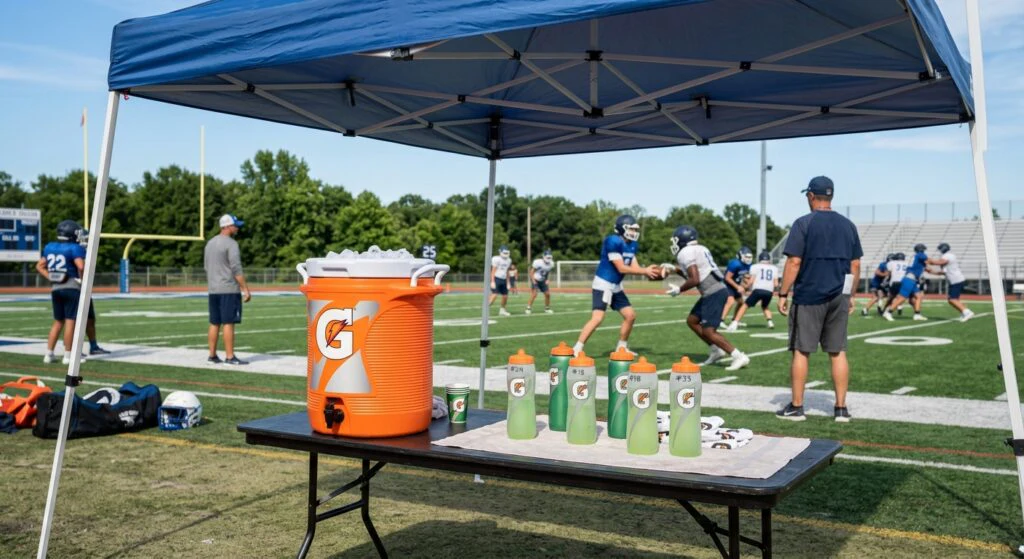
The model policy itself defines a 14-day preseason acclimatization period, and its structure will look familiar to anyone who’s followed a neighboring state’s football program:
Days 1–5. One practice per day, maximum 3 hours, with an optional 1-hour walkthrough as long as it’s separated from practice by at least 3 hours of continuous rest. Football players wear helmet only on days 1 and 2, then helmet and shoulder pads on days 3 through 5, with contact limited to blocking sleds and tackling dummies once shoulder pads are added.
Days 6–14. Full protective equipment and full contact are permitted. Double-practice days, allowed starting on day 6, must be followed by a single-practice day or rest day, and total practice time across a double day is capped at 5 hours, with no single session longer than 3 hours.
The physiological reasoning behind the 14-day window, rather than a shorter one, comes down to timing: sweat rate keeps increasing through roughly day 14, but the changes that matter most for avoiding heat illness, a lower heart rate and lower core temperature at a given exercise intensity, largely driven by an increase in blood plasma volume that helps carry heat to the skin, mostly max out by around day 7. That’s also consistent with research on illness rates by practice day: heat-related illness runs highest in the first five days of a new practice period, drops substantially by day six, and levels off further by day nine to eleven.
Cold Water Immersion and Emergency Action Plans
Maryland law requires a stock tank or inflatable pool at every school-sponsored athletic practice and event statewide, not tied to a specific temperature threshold; it has to be there regardless of the day’s forecast. The state’s own EMS protocol supports cooling a suspected exertional heat stroke victim before transport, and defines the athlete as safe to transport once core body temperature is between 101°F and 102°F, confirmed by rectal thermometry, the only field method considered reliable for this purpose. Removing someone from cold water immersion before reaching that range can render the treatment ineffective.
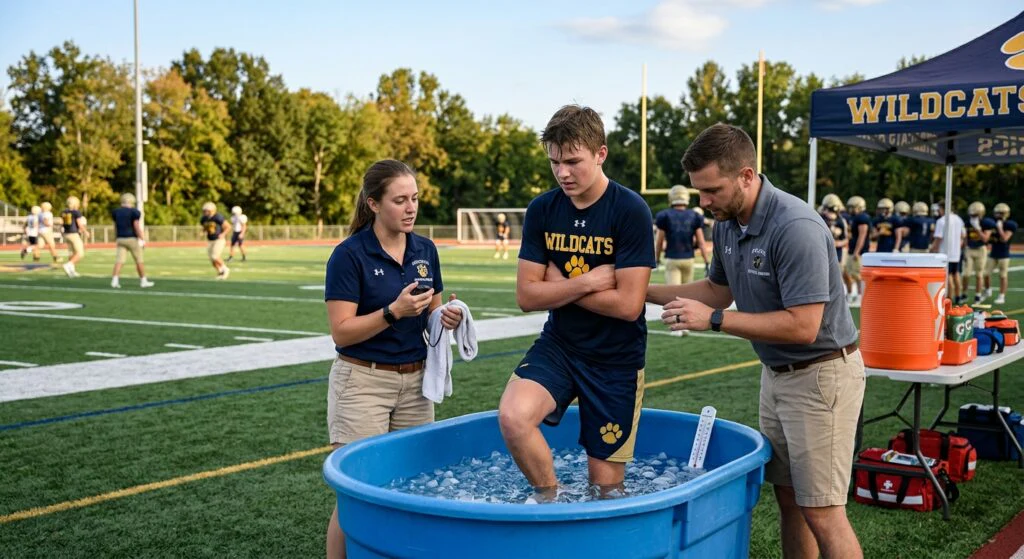
Cooling speed depends heavily on body size, something Dr. Martin has seen directly through years of work at the Falmouth Road Race:
“There was a woman who crossed the finish line, a national record holder for the 10K, and she had exertional heat stroke. We got her into a cold tub, but she weighed about 90 to 95 pounds, so it only took eight minutes to cool her. We’ve had people cross the finish line who are way more than 200, 250 pounds, and they might be in the tub for 30 or 40 minutes. There’s going to be different cooling rates depending on how much body mass these people have.”
– Dr. David Martin, Director of Science, Perry Weather
That range is exactly why rehearsing an emergency action plan with only a light, cooperative volunteer doesn’t prepare a staff for the version of this emergency that’s more likely to happen. Heat stroke’s central nervous system symptoms can include agitation and irrational behavior, not just confusion, and Dr. Martin described a real example from the same race:
An emergency action plan also has to account for logistics beyond the cooling itself: which gate EMS needs to access, the fastest route to a given field, and who’s in charge at each stage of a hand-off. Coordinating directly with local EMS ahead of time, rather than assuming they already know a campus’s layout, turns a plan on paper into one that works under pressure.
Hydration Education
The human body can absorb roughly 1 to 1.5 liters of water an hour, a capacity that can be trained upward somewhat over time, but some defensive linemen lose 4 liters an hour or more, especially athletes in the 300-to-330-pound range. That gap means giving an athlete a five-minute water break mid-practice was never going to fully replace what they’re losing; the real correction has to happen after practice, drinking enough to get back to pre-practice body weight, with electrolytes included rather than plain water alone, since sweat carries out sodium, chloride, and potassium along with water.
Maryland’s model policy gives specific hydration targets: 16 ounces of fluid two hours before activity, another 8 to 16 ounces fifteen minutes before, 4 to 8 ounces every 15 to 20 minutes during activity (up to 48 ounces an hour for heavy sweaters), and 16 to 20 ounces for every pound lost after activity. Athletes should be weighed before and after warm-weather practices to track this directly rather than guessing.
The stakes are concrete: for every 1 percent an athlete is dehydrated, core temperature rises roughly 0.17 to 0.2 degrees Celsius, and at 2 percent dehydration in hot conditions, aerobic performance can drop by around 10 percent. An athlete who doesn’t fully rehydrate overnight starts the next day’s practice already behind, and that deficit compounds rather than resets, which is part of why urine color checks and voiding frequency are useful low-cost ways to catch cumulative dehydration before it becomes a bigger problem.
How Perry Weather Helps Maryland Schools Stay Compliant
A Perry Weather station monitors WBGT continuously and on-site, feeding real-time, hyper-local data, temperature, precipitation, feels-like, WBGT, wind speed and chill, directly to a dashboard and mobile app rather than requiring a coach or athletic trainer to walk out with a handheld device. Schools can configure policies that automatically notify coaches, athletic directors, and athletic trainers the moment a threshold is crossed, with the specific protocol required at that level attached to the alert rather than a bare number.
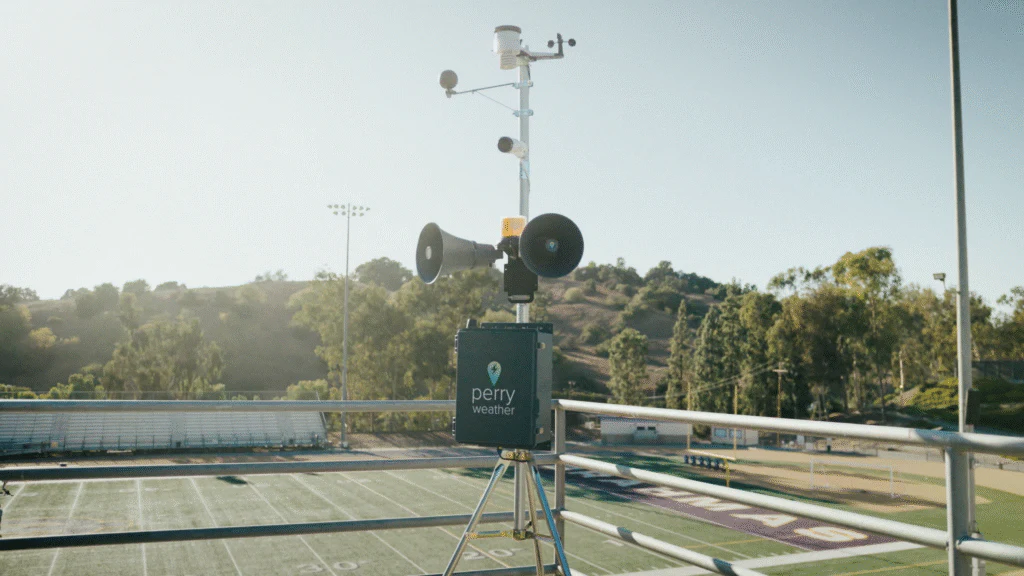
The same platform covers lightning detection, and Perry Weather’s in-house meteorology team is available to help with decisions like shifting practice to the morning during an extended hot stretch, planning around a forecast rather than reacting to conditions once athletes are already on the field.
If you want to see what automated WBGT monitoring looks like on your campus, get a quote today.


