


South Carolina requires a scientifically approved, on-site wet bulb globe temperature (WBGT) instrument at every practice, a cold immersion tub or equivalent kept ready whenever WBGT hits 82°F, and a written, venue-specific emergency action plan. All of it was covered on this call while the Lowcountry itself sat under an actual heat dome, well above 92°F most afternoons for the two weeks leading up to it.
We sat down with Mark Buchman, athletic director at Wando High School in Mount Pleasant, and Dr. Robert Huggins of the Korey Stringer Institute, alongside Dr. David Martin of Perry Weather, to walk through what SCHSL requires and what it actually looks like to run this policy in real time. Here is what they covered.
The History of Heat Illness in High School Athletics
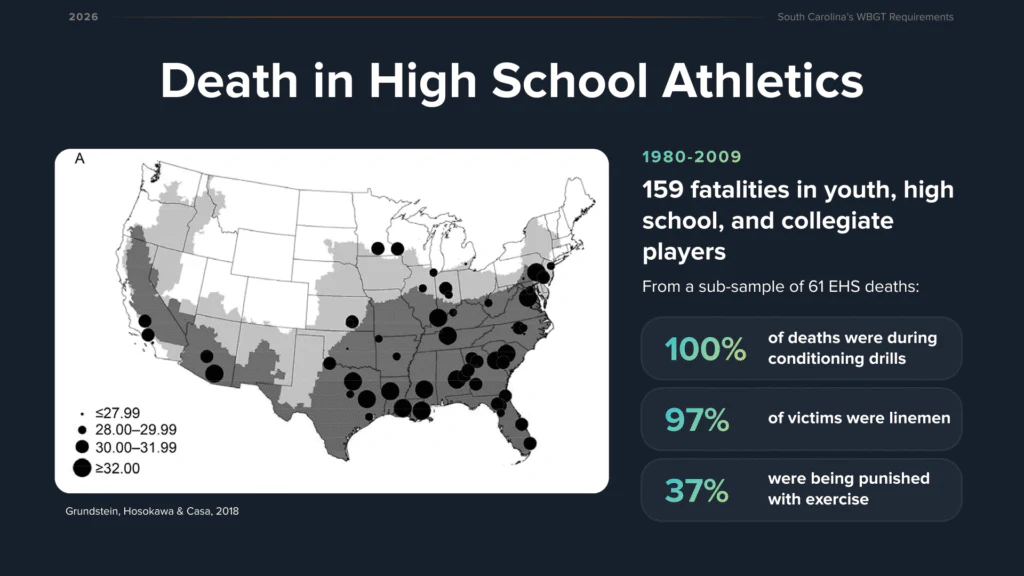
Between 1980 and 2009, there were 159 heat stroke fatalities among youth, high school, and collegiate players. Researchers who studied a sub-sample of 61 of those deaths found that 100 percent occurred during conditioning drills, 97 percent of the victims were defensive linemen, and 37 percent were being conditioned as punishment. A NATA position statement on conditioning linemen differently than the rest of a roster has already been accepted and should be in print soon. Dr. Huggins, who was involved in developing it, explained the physiology in plain terms:
“Linemen are also very close together on the field, so there’s not a lot of airflow, unlike a running back, wide receiver, or quarterback. And a lot of these kids are still growing into their bodies, skeletally immature, many of them in high school.”
– Dr. Robert Huggins, President of Occupational Safety & Athlete Performance, Korey Stringer Institute
On the map plotting every fatality against the WBGT recorded at the time and place it happened, most cluster in the Southeast above 32°C, with a few stretching as far north as New Jersey. A handful of deaths also happened well below that range, a reminder that a comfortable-looking number doesn’t rule out risk entirely.
The Georgia Study That Started It All
The research that turned this data into working policy came out of the University of Georgia. Andrew Grundstein and colleagues proposed breaking WBGT into risk categories, and at each threshold, requiring specific changes: more hydration breaks, shorter practice time, less equipment. Once those changes were tracked before and after implementation, heat-related illness fell almost 40 percent in the 82–86.9°F range, nearly 80 percent in the 87–89.9°F range, and close to 100 percent in the hottest range.
That result is a large part of why WBGT-based policy has since spread state by state, South Carolina’s included.
What is Wet Bulb Globe Temperature?
A phone’s weather app shows ambient temperature, air temperature alone, and it doesn’t account for how the environment affects a body that’s actively exercising. Heat index adds humidity, but the formula behind it was built around a man walking in the shade in long clothing, not an athlete in direct sun. It leaves out solar radiation and exertion entirely.
| Measurement | What it accounts for | Why it falls short for athletics |
|---|---|---|
|
Ambient temperature
|
Air temperature only. | Ignores humidity, sun, and wind. Two days at the same reading can carry very different risk. |
|
Heat index
|
Air temperature and humidity. | Built for a person walking in the shade in long clothing. Ignores solar load and wind, and athletes are not in the shade. |
|
Wet bulb globe temperature
Athletics standard
|
Air temperature, humidity, wind speed, and solar radiation. | It doesn’t. Measured on site, where the athletes actually are, which is why it’s the standard used by the military, OSHA guidance, and FHSAA. |
WBGT, invented by the military in the 1950s after a wave of heat-related illness and death training troops for World War II, combines four factors instead of one or two: air temperature, humidity, wind speed, and solar radiation. Once the military implemented a flag policy built around it, similar to the Georgia study, they saw a huge drop in heat-related illness, and the standard spread from there into athletics and occupational health.
The SCHSL WBGT Zones
Source: SCHSL Heat/WBGT Policy.
Mark Buchman, who is also an athletic trainer, connected the equipment rules directly to a coaching habit that used to put linemen at the most risk:
“In the past, you could see coaches having all linemen doing gassers, sprinting across the field and back. What Dr. Huggins is getting at is: let’s break the bigger guys down into shorter bursts of energy over shorter distances.”
– Mark Buchman, Athletic Director, Wando High School
One rule matters more than the raw numbers: once a WBGT reading has held in a range for 15 minutes, the restrictions for that range apply and can’t be relaxed even if conditions ease up moments later, and time already spent under a stricter range doesn’t reset when the reading briefly drops. The same logic runs in reverse: if conditions climb into a new range and hold for 15 minutes, the tighter restrictions kick in immediately.
Measurement Requirements
A scientifically approved WBGT instrument, not a phone app, has to be on site and used directly on the playing surface. Readings start 30 minutes before activity and continue every 30 minutes throughout. Devices need recalibration every two years, or sooner if the manufacturer recommends it.
Dr. Huggins emphasized that a single reading from one spot on campus doesn’t necessarily represent every field a team might use:
“Be careful of microclimates. On a hot day when you don’t have practice, go out to different areas of campus and get an idea of where your hot zones might be. Maybe it’s the surface they’re on, or the airflow between buildings, or shade from a tree line or the stadium itself.”
– Dr. Robert Huggins, President of Occupational Safety & Athlete Performance, Korey Stringer Institute
Emergency Action Plans and Cold Water Immersion
A cold immersion tub, or another method that uses water, has to be ready to use the moment WBGT reaches 82°F, typically kept available from May through October. If a tub isn’t available, a TACO method setup, a tarp with water and ice around the athlete, or even a baby pool sized for the torso and hips, are next in line. Cool first, transport second: cooling starts immediately, and EMS gets activated only after that process is underway.
Dr. Huggins was candid that reaching out to local EMS ahead of time is a step he didn’t always take himself:
“Reach out now to your local EMS providers. I am guilty of this myself. When I was a club sports athletic trainer, I did not do this process. I was intimidated by it, I didn’t know how it would be received. They want to save lives just like you, and you’re the expert in how to do this.”
– Dr. Robert Huggins, President of Occupational Safety & Athlete Performance, Korey Stringer Institute
South Carolina’s own EMS protocols were updated for the 2026 season to require cool-first, transport-second directly, matching what SCHSL’s own guidelines already state: don’t transport until rectal temperature is confirmed below 102°F, and stop active cooling once it reaches 101 to 102°F, since the body continues to drop in temperature for a period after cooling ends.
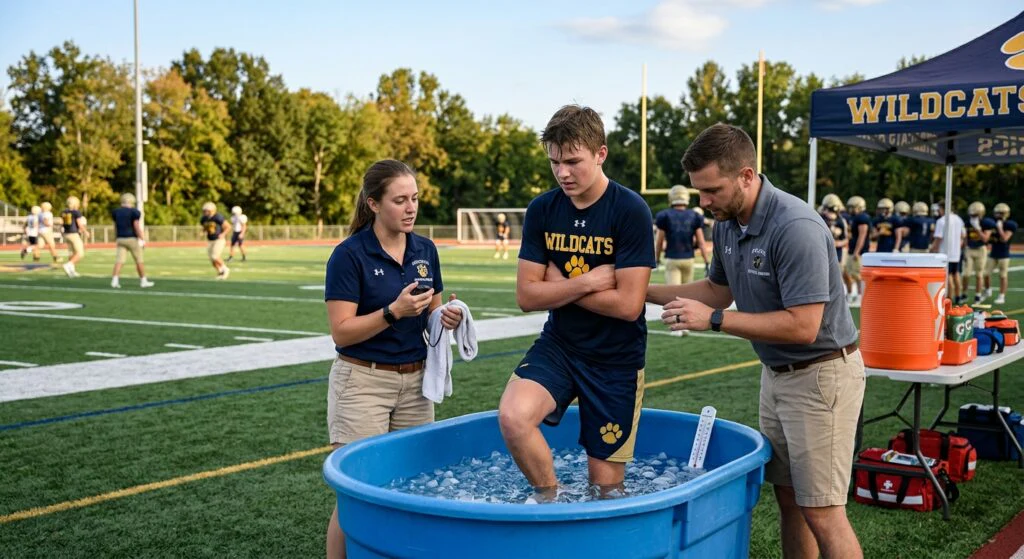
Rehearsing that plan with a realistic body type matters as much as having the tub ready. Dr. Huggins described a recent case that illustrates why:
“I treated a woman last week who was 110 degrees. She was 41 years old, maybe 145 pounds, and it took me 45 minutes to cool her, because she fought us the entire time. When someone’s fighting, they’re generating even more heat, which makes it take longer. Please practice your EAP with a 300-pound lineman, not just a smaller volunteer, and see what challenges that poses to your ability to actually get someone into a tub and hold them there.”
– Dr. Robert Huggins, President of Occupational Safety & Athlete Performance, Korey Stringer Institute
A rectal thermometer, not central nervous system status, has to guide when someone comes out of the tub; Dr. Huggins noted he’s treated people who stayed unconscious the entire time they were cooling, which tells you nothing about their actual core temperature. If a dedicated rectal thermometer isn’t available, an oral thermometer used rectally is still a valid rectal reading, imperfect but far better than guessing; the one thing it can’t be replaced with is an oral, tympanic, axillary, or forehead reading taken the normal way, none of which are considered reliable for someone who has been exercising in the heat.
Hydration and Recognizing Heat Illness
Water access is unrestricted, not scheduled around breaks, and an athlete is never denied it. Helmets come off during rest time, and rest happens in shade, whether that’s a tree, a building, or a pop-up tent.
The physiology behind hydration requirements is worth knowing directly: a football player can lose up to four liters of sweat an hour, but the stomach can only absorb one to one-and-a-half liters in that same hour. An athlete who leaves practice down four percent of their body weight and doesn’t fully rehydrate overnight starts the next day already behind, and that deficit compounds day over day rather than resetting.
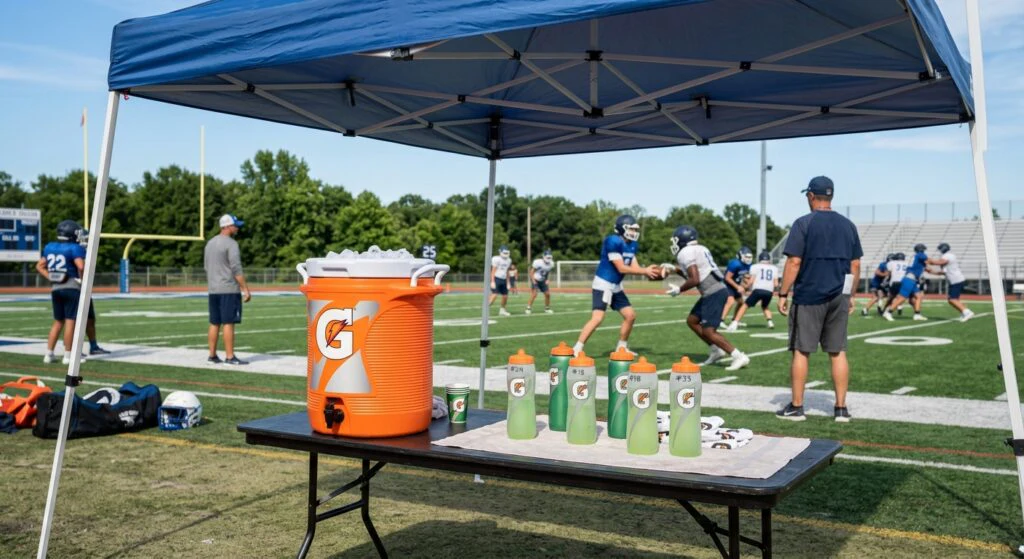
For every 1 percent an athlete is dehydrated, core temperature rises roughly 0.15 to 0.2 degrees Celsius. SCHSL’s own guidance recommends weighing athletes before and after practice to catch anyone losing more than 2 percent of body weight, and watching urine color, aiming for something close to light yellow or lemonade rather than dark.
Recognizing which heat illness is actually happening changes what to do next. Heat exhaustion involves difficulty continuing exercise and a body temperature usually between 101°F and 104°F, without central nervous system dysfunction; heat syncope is a sudden drop in blood pressure tied to standing still or stopping abruptly, showing up as dizziness or fainting.
Exertional heat stroke is different in kind, not just degree: a rectal temperature above 104.9°F combined with central nervous system dysfunction, confusion, irritability, disorientation, or altered consciousness. Any one of those CNS signs, on its own, is enough to assume heat stroke and start cooling immediately rather than waiting for a temperature reading to confirm it.
Do the Rules Change for Games?
Yes, though less than people sometimes assume. During warmups, football players should remove helmets and shoulder pads once WBGT crosses 87°F. If WBGT is between 87.0°F and 92.1°F at kickoff, a mandatory three-minute hydration break happens at the halfway point of each quarter, with helmets off and unlimited water access. Above 92.1°F, competitions in every sport are postponed until the reading drops back below that line.
Two-way players, and athletes filling in across multiple levels in the same day, like a kid who plays JV in the morning and varsity later, deserve closer attention than the roster average. Dr. Huggins explained why:
“Heat strokes don’t typically happen in competition, most happen in practice. But a two-way player is working more similarly to what an athlete experiences in practice, more total playing time in the heat. Make sure you’re paying special attention to those specific kids and cueing in your coach, especially at what would normally be a red or black flag.”
– Dr. Robert Huggins, President of Occupational Safety & Athlete Performance, Korey Stringer Institute
Swimming has its own separate rule: combined air and water temperature should stay between 118°F and 177.4°F, based on 2023 USA Swimming and USA Triathlon guidance, since the usual WBGT framework doesn’t map cleanly onto an indoor pool environment the way it does to a football field.
Heat Acclimatization
The reasoning behind a mandatory acclimatization period comes down to timing: roughly 90 percent of the physiological adaptations that protect against heat illness happen within 5 to 7 days of consistent activity, and the highest concentration of heat-related illness and heat stroke shows up in that same window, the first days back from a layoff or the first days of a brand-new activity.
That risk isn’t limited to the start of the season. A stretch of unusually cool weather in early spring followed by a sudden hot week creates the same kind of transition risk, and a full week off due to heat cancellations, like the one Wando’s middle school team just went through, means those athletes haven’t banked the same adaptation as a team that got to practice on schedule.
How Perry Weather Helps South Carolina Schools Stay Compliant
Placement matters as much as the instrument itself. Perry Weather typically reviews 24 hours of sun exposure for a given location to make sure a station gets sun at the same time the actual playing surface does, positioned as close to the field as practical while staying out of the way of equipment, vehicles, and emergency access routes. Many schools mount it on a fieldhouse or press box roof, a central point that also gives lightning-detection coverage across every field on campus at once.
That single station covers more than football. Wando’s coaches, band, and even ROTC all have their own accounts to check conditions directly, and cross country, which travels four or five miles from campus to practice in the woods, and golf, which doesn’t have a course on-site, can both set up readings for wherever they’re actually training that day rather than relying on a number measured somewhere else on campus.
If you want to see what automated WBGT monitoring looks like on your campus, get a quote today.
We tried to order a rectal thermometer, but it was on backorder, so we ordered the rectal attachment for a Welch Allyn thermometer instead. Is that sufficient for a rectal temperature reading?
Yes, it gives an accurate reading, just not a continuous one. Cold water immersion typically cools someone 0.2 to 0.3°C per minute, so plan on 15 to 20 minutes before reassessing with the thermometer, not by consciousness, and keep cooling until they’re back in the 101–103°F range.
If we don’t have access to a rectal thermometer, or the funds for one, is 30 minutes of cooling still best practice, or what would you suggest instead?
Cooling time varies too much by body size to guess, from as little as 6 to 8 minutes for a small athlete to 30 to 40 minutes for a large one, so use an oral thermometer rectally rather than not measuring at all. If you see confusion, irrational behavior, or altered consciousness, that alone is enough to assume heat stroke and start cooling immediately without waiting on a number.