


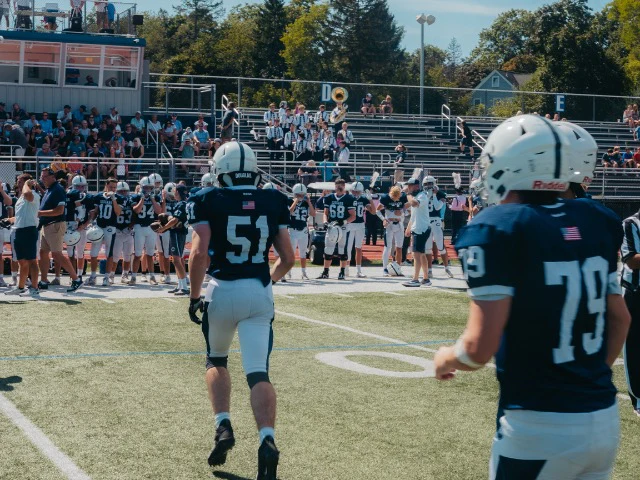
New Jersey’s wet bulb globe temperature (WBGT) policy requires monitoring at every practice, hourly logged readings, and a 150-gallon cold water immersion tub with water kept under 60°F, reachable within 5 to 10 minutes of wherever activity is happening.
The History of Heat Illness in High School Athletics
Between 1980 and 2009, there were 159 heat stroke fatalities among youth, high school, and collegiate players. Researchers who studied a sub-sample of 61 of those deaths found that 100 percent occurred during conditioning drills, 97 percent of the victims were linemen, and 37 percent were being conditioned as punishment. A NATA position statement is due out soon specifically on conditioning linemen differently from the rest of a roster, since their larger body mass means they generate metabolic heat faster and cool down slower than other players.
On the map plotting every fatality against the WBGT recorded at the time and place it happened, most cluster in the Southeast, in Florida, Georgia, and Louisiana, but the pattern stretches north into New Jersey too. A handful of deaths also happened at cooler temperatures, a reminder that a comfortable-looking number doesn’t rule out risk entirely.

The Georgia Study That Started It All
The research that turned this data into working policy came out of Georgia. An athletic trainer with years of historical WBGT and heat-illness data proposed breaking WBGT into risk categories, and at each threshold, requiring specific changes: more rest, more hydration breaks, less total practice volume. Once those changes were tracked before and after implementation, heat-related illness fell almost 40 percent in the 82–86°F range, nearly 80 percent in the 87–89°F range, and a full 100 percent in the 90–92°F range.
That result is a large part of why WBGT-based policy has spread state by state since, New Jersey’s included.

What is Wet Bulb Globe Temperature?
A phone’s weather app shows ambient temperature, air temperature alone, and it says nothing about how a body handles exercise in that air. Heat index adds humidity, but the formula behind it was built around someone walking in the shade with a slight breeze, in long clothing, not an athlete in direct sun. It leaves out solar radiation and exertion entirely.
| Measurement | What it accounts for | Why it falls short for athletics |
|---|---|---|
|
Ambient temperature
|
Air temperature only. | Ignores humidity, sun, and wind. Two days at the same reading can carry very different risk. |
|
Heat index
|
Air temperature and humidity. | Built for a person walking in the shade in long clothing. Ignores solar load and wind, and athletes are not in the shade. |
|
Wet bulb globe temperature
Athletics standard
|
Air temperature, humidity, wind speed, and solar radiation. | It doesn’t. Measured on site, where the athletes actually are, which is why it’s the standard used by the military, OSHA guidance, and FHSAA. |
WBGT, invented by the military in the 1950s, combines four factors instead of one or two: air temperature, humidity, wind speed, and solar radiation, weighted heavily toward how effectively a body can evaporate sweat to cool itself. Dr. Martin illustrated how far that number can drift from what a phone shows, drawing on research in the New Mexico desert:
“The ambient temperature outside was 106°F, but the humidity was around 20 to 30 percent, and we were just going from 88 into 89 WBGT. Maybe it’s 92 or 91 degrees, but the humidity is much higher, 70 percent. That’s going to push the WBGT value up much higher, because it’s a combination of ambient temperature with humidity and other factors.”
– Dr. David Martin, Director of Science, Perry Weather
The NJSIAA WBGT Zones
New Jersey follows a single statewide chart.
One rule catches coaches off guard: the moment WBGT crosses into a lower time cap, time already spent practicing counts against it. A team thirty minutes into a planned three-hour practice that crosses into the 85.1–88.0°F range doesn’t get a fresh two hours; it gets an hour and a half more, for two hours total. Before Perry Weather existed, that kind of shift reached coaches as a bare number with no context.
Measurement Requirements
30 minutes before. Set up the on-site instrument before practice starts. A black globe sensor needs time to absorb radiant heat from the sun and reach a reliable reading; a reading taken the moment the device is placed outside isn’t valid yet.
Every hour during. Re-read throughout practice and record the reading on the NJSIAA Heat Participation Policy Record Chart. Readings should come from an athletic trainer or a certified designee, and activity should adjust at each WBGT level change.
Dr. Martin explained why the cadence is measured in an aggregate window rather than a constant stream of readings:
“It’s not every five minutes, not every two minutes, because weather can fluctuate. A cloud can come by, block the sun, and the temperature can drop. Then a coach says, hey, it’s four degrees lower now because of that cloud, so we can practice for two hours instead of one. No. We take that aggregate over 30 minutes to an hour so it doesn’t fluctuate as much.”
– Dr. David Martin, Director of Science, Perry Weather
That measurement discipline matters more given who’s actually expected to take the readings. Athletic trainers already spend practice taping ankles, checking on injuries, and making sure kids are cleared to play; walking a device outside, holding it up, and coming back in repeatedly isn’t a good use of the little time they have.
Hydration and Cold Water Immersion
Hydration is unrestricted, not scheduled. Athletes must have access to water at all times, and an athlete is never denied water. Helmets come off during rest time for sports that require them, the rest site has to be in a shaded area, and once WBGT crosses 85.0°F, ice towels and spray bottles filled with ice water, or an equivalent, must be available.
The physiology behind that requirement is worth knowing directly. A football player can sweat three to four liters an hour, but the stomach can only empty roughly one to one-and-a-half liters an hour, so even generous 20-minute breaks aren’t enough to fully replace what’s lost. For every 1 percent an athlete is dehydrated, core temperature rises 0.17 to 0.2 degrees Celsius; at 2 percent dehydration, aerobic fitness can drop 10 percent or more in hot conditions. An athlete who doesn’t get back to their pre-practice body weight overnight starts the next day already behind.
Cold water immersion has specific, non-negotiable equipment requirements. Cool first, transport second: core temperature needs to reach 103°F using cold water immersion or another approved technique before transport. A cold water immersion tub is required on any day WBGT is above 80°F. NJSIAA’s cold water immersion policy gets specific by flag color: a 150-gallon tub or a tarp using the TACO method, water kept under 60°F, accessible within 5 to 10 minutes of the activity site, with clothing and equipment removed before or immediately upon entering, and the water kept aggressively stirred rather than left still.
Do the Rules Change for Games?
Yes, and the reasoning traces back to the same fatality data covered above: every recorded heat stroke death happened during conditioning practice, not competition. A game’s built-in stop-start structure gives the body more chances to cool than a continuous practice does, and neither NJSIAA nor the Korey Stringer Institute has found a basis yet for applying practice-style time caps to games.
Practices. WBGT guidelines and time limits are mandatory. Activity must be modified as WBGT rises from one level to the next, following the required monitoring cadence and recordkeeping.
Competitions. Activity limits don’t apply in the same way. Officials must be told the on-site WBGT reading at least 30 minutes before a contest starts. Required modifications include increased rest breaks, fluid access, and cooling zones. Equipment stays on during play, since removing it mid-game raises its own safety concerns, but must come off and be actively cooled during built-in breaks once conditions reach Orange or Red. If a Black flag is reached during a game, that triggers a mandatory 30-minute postponement and re-read; play cannot resume until conditions drop back below Black.
Required for both. A scientifically reliable WBGT device is required, with readings logged every hour, whether it’s a Tuesday practice or a Friday night game.
That gap between practice and competition rules is also the source of a common complaint: if a team had to cancel or shorten practice all week because of heat, is it really safe to play a game in the same conditions on Friday? Dr. Martin was direct that the concern is fair, even if the data doesn’t yet support extending practice-style limits to competitions: games in genuinely dangerous conditions still warrant real caution from coaches and officials, policy floor or not.
Heat Acclimatization Period
The data behind Georgia’s original study also showed heat illness concentrated most heavily in the first five days of practice, and in the first hot stretch after a cold snap, not just at the start of a season. NJSIAA’s acclimatization period runs 14 consecutive days for every student-athlete, including anyone who joins after day one, and if practice runs six consecutive days, a full rest day is required before continuing.
Days 1–5. One practice per day, up to 3 hours. A 1-hour walkthrough is permitted if separated from practice by at least 3 hours of continuous rest.
Days 1–2. For sports requiring helmets and shoulder pads, a helmet is the only protective equipment permitted.
Days 3–5. Helmets and shoulder pads may now be worn. Football may begin contact using blocking sleds and tackling dummies.
Day 6 and beyond. All protective equipment may be worn and full-contact drills may begin.
Days 6–14. A double-practice day must be followed by a single-practice day. Doubles are capped at 3 hours each and 5 hours total, separated by at least 3 continuous hours of rest.
How Perry Weather Helps New Jersey Schools Stay Compliant
A Perry Weather station monitors WBGT continuously and on-site, so the 30-minutes-before setup and hourly re-reads NJSIAA requires happen automatically rather than depending on someone walking a handheld device outdoors repeatedly through practice. Every reading is logged, building the NJSIAA Heat Participation Policy Record Chart without anyone needing to fill it in by hand.
Automated alerts go out with the specific activity modification attached, not just a raw WBGT number, and they reach every coach and staff member configured to receive them, current staff only, which solves the exact problem Taylor Baca described: a manual, word-of-mouth process that depends on the right person remembering to pass along the right message to the right person, every single time.
If you want to see what automated WBGT monitoring looks like on your campus, get a quote today.


