


What is the WBGT right now?
The calculator above runs the math for you to give you an estimate of the WBGT. Enable location and the calculator will pull in current publicly available weather data for your location. If you have a VPN, the data will be more inaccurate.
This guide walks through what’s underneath the hood of the calculator, the WBGT formula OSHA uses for occupational heat stress, how the indoor and outdoor calculations differ, how to run the calculation manually, and the mistakes that cause readings to drift off-spec.
For background on what WBGT measures and how to interpret a reading, see our What Is WBGT? guide.
How to Calculate WBGT
WBGT combines three temperatures using a weighted formula:
Outdoor Formula — Direct Sunlight
WBGT = 0.7 × Tnwb + 0.2 × Tg + 0.1 × Tdb
Tnwb · 70%
Natural wet bulb — evaporative cooling capacity
Tg · 20%
Globe temperature — radiant heat from sun and surfaces
Tdb · 10%
Dry bulb — ambient air temperature in shade
This is the outdoor (with-solar-load) version of the formula you’d use for construction sites, road work, agriculture, utilities, and any other work in direct sun. For a full breakdown of what each component captures and why the weights work the way they do, see our “What is WBGT? guide.
A quick note on units: the formula works in either Celsius or Fahrenheit, but every input has to be in the same unit. Mixing °C and °F is one of the more common WBGT calculation errors and produces nonsense results.
How to Calculate WBGT Outdoor vs Indoor
Two WBGT Formulas
Outdoor (with solar load):
WBGT = 0.7 × Tnwb + 0.2 × Tg + 0.1 × Tdb
Indoor (no solar load) — per the OSHA Technical Manual:
WBGT = 0.7 × Tnwb + 0.3 × Tg
How Indoor Wet Bulb Globe Temperature is Different
The indoor formula keeps the globe term — it doesn’t drop it.
Without direct sunlight, dry bulb and globe temperatures are nearly equal in a radiant-heat-free environment, so the dry bulb term drops out.
But most industrial workplaces aren’t radiant-heat-free.
Foundries, kitchens, bakeries, manufacturing floors near ovens, kilns, and presses all generate significant non-solar radiant heat. The globe thermometer captures it. A dry bulb doesn’t.

Wind Speed and Sensor Placement Indoors
Indoor airflow is HVAC-driven and predictable and wind isn’t the variable it is outdoors. Radiant heat from equipment is. The same building can read 75°F WBGT near a loading dock and 92°F near to a furnace. Sensor placement matters as much as the formula.
Indoor WBGT Monitoring with Perry Weather
Perry Weather’s indoor WBGT monitoring system uses multiple sensors to monitor & record heat index and WBGT across your facility.
How to Calculate WBGT from Your Phone
What Phone Apps Actually Use
Most apps and online calculators use the Stull equation, estimating wet bulb from temperature and relative humidity alone. The NWS publishes experimental WBGT forecast grids that some apps pull from. The OSHA-NIOSH Heat Safety Tool provides heat index — not WBGT — with workload guidance.
Where Phone WBGT Estimates Fall Short for Heat Stress Decisions
- Distant source data. Inputs typically come from an NWS station 5–25 miles away. Local sun exposure, surface heat, and wind patterns won’t be reflected.
- No solar radiation or wind. Error margins of 8–15°F are realistic on sunny, low-wind days.
- No documentation trail. Inspectors want timestamped, location-specific records tied to your heat illness prevention plan. App screenshots don’t qualify.
Phone estimates are fine for scheduling and awareness, but on-site measurements will always be the best option.
Effortless WBGT Monitoring
An on-site Perry Weather station measures and logs WBGT every 5 minutes, and sends you an alert when conditions cross your custom thresholds.
How Is Globe Temperature Calculated for WBGT
Direct Measurement
A black globe thermometer is a hollow copper sphere, painted matte black, with a thermometer suspended in the center. It absorbs solar and infrared radiation the way the human body does. The OSHA Technical Manual specifies a 6-inch (15.2 cm) globe. Larger globes produce more stable readings — smaller globes in handheld units spike erratically when the sun shifts or when there is sporadic cloud cover. Allow 15–20 minutes for stabilization before trusting a reading.
Estimation Methods
When a calibrated globe isn’t available:
- Dimiceli equation — developed at the NWS Tulsa office. Estimates globe temperature from solar radiation, air temperature, wind speed, and sun zenith angle. Powers experimental NWS WBGT forecast outputs.
- Liljegren method — used by OSHA and the U.S. military. Physics-based rather than statistical; accurate within ~1–2°F at military depots.
Both depend on accurate, local solar radiation and wind speed inputs — data most consumer apps don’t have.
Why Estimation Fails Indoors
There’s no standard model for predicting radiant heat from publicly available weather data. Indoors, direct globe measurement near the heat source is the only accurate approach.
What is the Gold Standard for WBGT Measurement?

ISO 7243 — What a Compliant Measurement Requires
Common Commercial Deviations
| 1 |
Smaller globes with correction factorsMost handhelds use 1–2″ globes and convert mathematically. Faster response, but prone to momentary spikes when sun or wind shifts. |
| 2 |
Psychrometric wet bulb estimatesCalculated from temperature and humidity rather than a wetted wick — maintaining a true natural wet bulb is impractical in field conditions. |
| 3 |
Insufficient radiation shieldingAn unshielded dry bulb in direct sun reads higher than true air temperature, skewing WBGT upward. |
Where Perry Weather Sits
Perry Weather uses a stationary 3.5″ black globe with a radiation-shielded temperature sensor — larger than typical handheld globes, producing readings very similar to that of a 6-inch black bulb globe temperature reader.
On the software side, Perry Weather calculates Tnwb in two stages rather than using a simplified shortcut. First, it derives psychrometric wet bulb from air temperature, dew point, and barometric pressure using iterative Newton’s method — making it more physically grounded than the Stull method most apps use.

Accurate WBGT Monitoring without the Hassle of Handhelds
Handheld devices require someone to carry them, position them correctly and log readings manually. Perry Weather does it all – automatically.
How to Calculate WBGT Manually
Maintaining a true natural wet bulb in the field is impractical — clean distilled water, intact wick, 15–20 minutes to equilibrate, no contamination. The good news: you don’t need the wick. Tnwb can be calculated from standard sensor inputs.
What Tnwb Is Actually Measuring
Natural wet bulb answers one question: given current humidity and airflow, how much can evaporation cool a wet surface? Two variables govern the answer:
- Humidity — the higher it is, the less evaporation is possible
- Wind speed — more airflow accelerates evaporation; at low wind, even dry air provides limited cooling
The Stull Method: Fast, Humidity-Only
Step-by-Step Calculation
Dry bulb temperature (Tdb)
Radiation-shielded sensor in genuine shade, away from hot surfaces. This reads true air temperature — not what the sun is heating around it.
Dew point (Td) and wind speed
Both measured at the work location — not from a distant station. Together they define the evaporative cooling ceiling workers are actually operating under.
Globe temperature (Tg)
Black globe sensor placed at the work location — in direct sun outdoors, near the heat source indoors. Allow 15–20 minutes to stabilize before reading.
Estimate Tnwb
Feed Tdb, dew point, surface pressure, solar flux, and wind speed into the Blaine Thomas method. Perry Weather’s system does this automatically with every sensor reading.
Apply the formula
Outdoor
0.7 × Tnwb + 0.2 × Tg + 0.1 × Tdb
Indoor
0.7 × Tnwb + 0.3 × Tg
Worked Example 1: Outdoor Construction Site
| Input | Value |
| Dry bulb (Tdb) | 92°F |
| Relative humidity | 65% |
| Wind speed | 3 mph (low) |
| Globe temp (Tg) | 108°F |
Stull (T + RH only) → Tnwb ≈ 82°F. Perry Weather’s method (adding low wind + solar flux) → Tnwb ≈ 83°F.
- 0.7 × 83 = 58.1
- 0.2 × 108 = 21.6
- 0.1 × 92 = 9.2
- WBGT = 88.9°F
Worked Example 2: Indoor Manufacturing, Near-Zero Airflow
| Input | Value |
| Dry bulb (Tdb) | 84°F |
| Relative humidity | 70% |
| Wind speed | ~0.5 mph (HVAC only) |
| Globe temp (Tg) | 105°F (radiant from press) |
With 70% humidity and near-zero airflow, evaporative cooling is almost entirely humidity-constrained. Tnwb ≈ 78°F.
- 0.7 × 78 = 54.6
- 0.3 × 105 = 31.5
- WBGT = 86.1°F
Common WBGT Calculation Mistakes
| 1 |
Mixing unitsAll inputs must be in the same unit — Celsius or Fahrenheit throughout. Mixing the two produces nonsense results. |
| 2 |
Wrong formula for the environmentOutdoor formula in shade, or dropping the globe term near indoor radiant heat sources, both misrepresent actual heat load. |
| 3 |
Wet wick drying outA dry wick reads near dry bulb, artificially lowering WBGT. Keep it saturated with clean distilled water. |
| 4 |
Globe not stabilizedReading before 15–20 minutes of equilibration produces an unreliable Tg. |
| 5 |
Dry bulb in partial sunMust be in genuine shade. Even partial sun pulls the reading up and skews WBGT. |
| 6 |
Sensor not at the work locationA globe in a shaded hallway near a hot line reads lower than one where workers stand. OSHA expects measurements at the work location. |
| 7 |
Reading during a transitionCloud cover changes, wind shifts, and furnace cycles all disturb readings until conditions settle. |
| 8 |
Trusting a single handheld spikeSmall-globe units respond quickly but spike easily. Average across several minutes for a reliable reading. |
| 9 |
No documentationA correct reading without a timestamped log doesn’t satisfy OSHA recordkeeping expectations under the revised NEP. |
Most errors come from inputs and setup, not the formula.
The Bottom Line on WBGT Calculation
Getting a WBGT reading isn’t the hard part. Getting one that’s accurate, documented, and easy to implement into your workflow is. Perry Weather handles all of it.
On-site monitoring
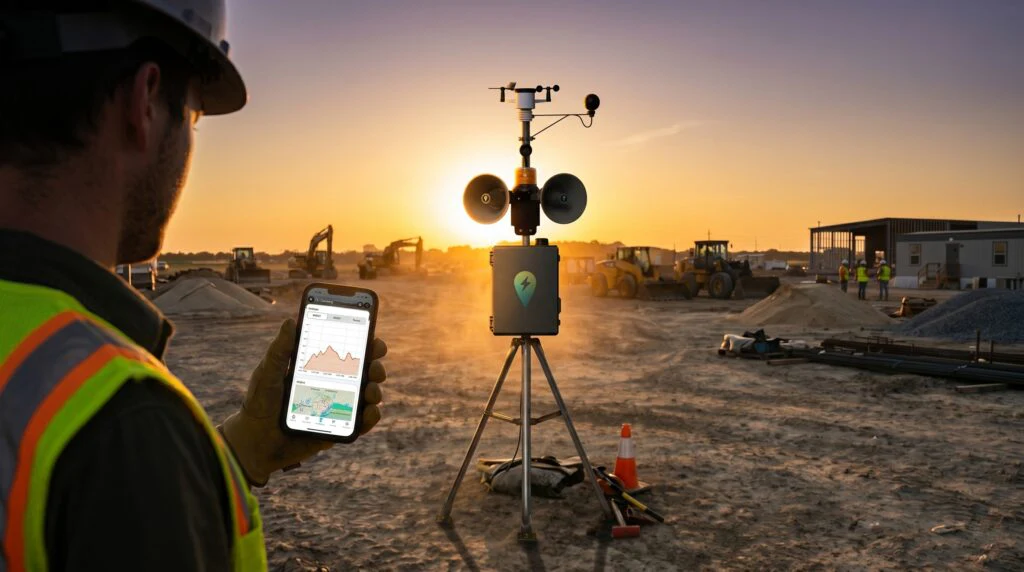
A permanent station at your location measures WBGT from actual conditions — your sun exposure, your wind, your radiant heat sources — not from a weather station miles away. Readings update every 5 minutes, continuously, without manual intervention.
Automatic recording
Every reading is timestamped and stored automatically. No manual logs, no reconstructed records, no gaps. When an OSHA inspector asks what conditions were at 1:45 PM last Tuesday, the data is already there.
Exportable reports
Historical WBGT data is exportable on demand — by date range, by threshold, by location. Useful for OSHA audits, workers’ comp reviews, incident documentation, and demonstrating ongoing compliance before anyone asks. Watch the video to see how it works.
Policy-based alerts
Set your own thresholds — by WBGT zone or heat index level — and Perry Weather alerts your team automatically the moment conditions cross them. The right people get notified, with the right instructions, at the right time. No one has to be watching a dashboard.
Try it free for 14 days
Stop calculating WBGT manually.
Calibrated sensors, automatic stabilization, policy-based alerts, and timestamped logs — Perry Weather handles the measurement so your team can focus on the safety decision.


