


El Niño is strengthening. How should weather-dependent organizations prepare for Winter 2026–27?
The El Niño 2026 winter forecast points to this year’s El Niño being one of the greatest on record. Experts anticipate the super climate event to result in above average temperatures and increased seasonal precipitation across the United States during winter 2026 – 2027. Organizations may see a wetter, stormier winter across the southern U.S. with milder conditions occurring in the northern U.S as El Niño shifts the winter storm track south.
El Niño 2026 Winter Forecast: How Could the Strengthening Climate Pattern Affect U.S. Weather This Winter?
El Niño is a recurring multiyear climate cycle that brings unusually warm ocean water to the central and eastern tropical Pacific, resulting in changes to temperatures, precipitation, wind, and pressure across the globe.
NOAA’s ENSO Diagnostics Discussion cites a greater than 90% chance of a very strong event during the Northern Hemisphere winter 2026-2027. This exceptionally powerful outlook is causing public agencies, schools, and other organizations to place increased emphasis on protecting their communities, resources, and vulnerable assets. In this article, the Perry Weather meteorology team provides an El Niño 2026 winter forecast and shares the operational implications for weather-dependent organizations across the United States.
What is El Niño?
An El Niño is a weather event that develops when sea surface temperatures are warmer than average in the equatorial Pacific for an extended period of time. This event has a predominant impact on winter weather patterns and is expected roughly every two to five years.
Historically, strong, or “super” El Niño winters only occur roughly every 16 years. But with an increase in greenhouse gases and the acceleration of climate change, this recurring pattern has been super-charged, in both intensity and frequency.
The impacts of El Niño are typically largest in the United States during October through May. Data from NOAA’s Oceanic Niño Index (ONI) records changes to oceanic temperature as well as changes to the placement of the subtropical jet stream. Preliminary data predicts a 90% chance of a historic event that exceeds the strength of previous El Niño events dating back to 1950. The ENSO Diagnostics Discussion meets regularly to provide commentary on El Niño’s strength and effects on United States weather. The next update is expected to be provided in early October.
|
See what developing winter weather could mean for your organization’s safety.
Perry Weather combines on-site monitoring with automated policy alerts, so you can plan with confidence this winter.
|
|
What is the El Niño forecast for winter 2026?
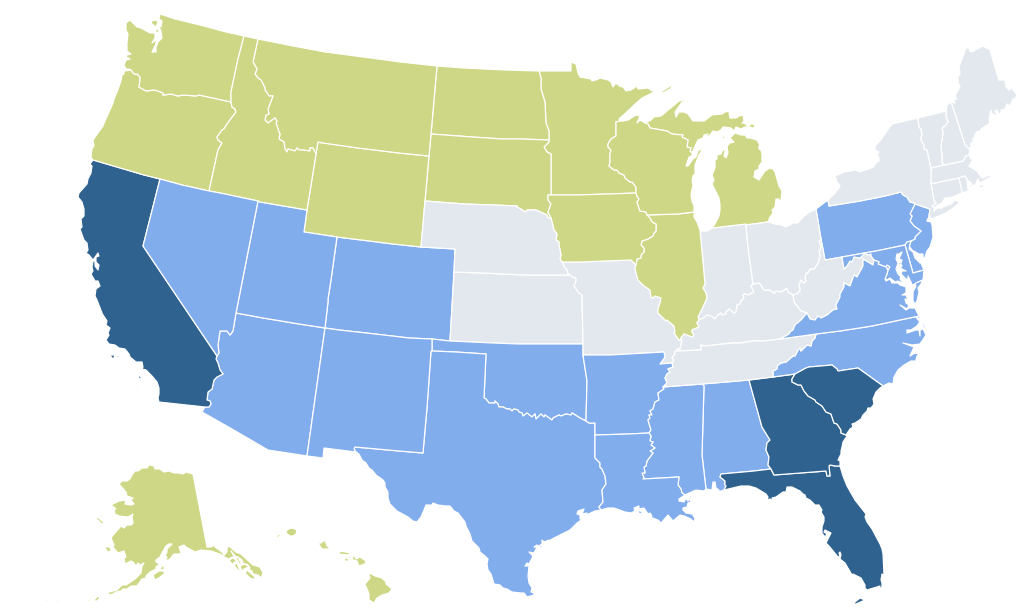
Much wetter
Wetter
No clear signal
Drier
Although each El Niño event is different, general winter weather patterns can be predicted based on the intensity of the event. For example, El Niño causes the polar jet stream to remain much farther north than usual, while the Pacific jet stream remains in its usual place across the southern United States. This keeps above-normal temperatures in the Midwest – often by four to five degrees – but also increases the likelihood of strong storms and potentially catastrophic coastal flooding in the South and Pacific regions.
The Perry Weather meteorology team cautions that El Niño shifts the odds; it does not guarantee what happens on any given day. A mild winter can still bring a brutal cold snap, and a stormy season will still have quiet stretches.
What did the CPC’s most recent update say about the 2026-2027 El Niño winter forecast?
The CPC’s most recent commentary predicts El Niño persisting through March-May 2026, with a 55% chance of the United States being ENSO-neutral in April-June 2027. At their most recent discussion, they found El Niño strengthening, as indicated by sea surface temperature anomalies and changes to the equatorial subsurface temperature index. Low-level westerly wind anomalies and upper-level easterly wind anomalies reflected a strengthening weather system.
With an event of this magnitude, the CPC cautions that the chances of experiencing impacts consistent with El Niño, such as wetter conditions in the southern U.S., milder temperatures across the north, and a southward shift in the winter storm track are increased – although not completely guaranteed.
What is the El Niño forecast for the Northeast and Mid-atlantic?
Northeasterners can expect a more wet winter than usual. “In the Mid-Atlantic and Northeast, the East Coast storm track may be busier than usual. With less cold air in place, organizations will likely see more precipitation – but more of it could fall as rain,” says Samantha Davies, a member of Perry Weather’s in-house meteorology team.
Davies cautions against expecting a completely mild winter. “El Niño just shifts the odds. It doesn’t guarantee what happens on any given day. A mild winter can still bring a brutal cold snap, and a stormy season will still have quiet stretches. El Niño winters have produced major snowstorms.”
What is the El Niño forecast for the South and Southeast?
Across the Gulf Coast and Southeast, expect a wetter, stormier winter, combined with milder temperatures. Changes in the positioning and strength of the subtropical jet stream can bring repeated periods of storm activity.
Davies says to look out for heavy rain, a higher flood risk, and a better chance of severe thunderstorms and lightning, even in the middle of the winter.
What is the El Niño forecast for the northwestern United States?
Across the northern United States, Davies forecasts an opposite phenomenon playing out. “You’ll see conditions milder and drier than normal, with fewer blasts of Arctic air and likely less snow.” The exact outcome varies by location.
A milder seasonal pattern is predicted, but it doesn’t completely eliminate the possibility of a major winter storm. Several such events have occurred in this region during El Niño years.
What is the El Niño forecast for California?
In California and the Southwest, the odds favor more storms and above-normal precipitation. “That’s good news for drought and mountain snowpack in the Sierra and southern Rockies, but it also raises the risk of flooding and mudslides,” says Davies.
On September 21, Governor Gavin Newsom issued a state of emergency to help California prepare before winter storms arrive. The state is staging flood-fighting supplies, preparing vulnerable roads and infrastructure, and coordinating with local partners. Organizations can take a similar approach at their own locations: identifying potential areas of hazard, deciding thresholds and policies in regards to when conditions require a closure or evacuation, and making sure the right people receive forecasts and alerts.
Will the 2026 El Niño winter forecast change?
PERRY WEATHER 2026 EL NIÑO FORECAST
What’s the winter outlook for your organization?
Enter a ZIP code or choose a location on the map to see NOAA’s latest three-month outlook.
A seasonal outlook describes the odds of above-normal, near-normal, or below-normal conditions over three months. It does not predict individual storms or site-specific impacts. Source: NOAA Climate Prediction Center. ZIP results use an approximate ZIP-area location.
NOAA predicts with near-certainty an especially strong El Niño event when compared to previous El Niño records dating back to 1950. However, NOAA’s CPC forecasts have changed substantially since March. And as winter 2026 approaches, regional temperatures and precipitation outlooks will become even more integral. Perry Weather’s on-call meteorologists help organizations interpret changing conditions with predictive forecasts meant to help operations plan for inclement or adverse weather.
|
Make the right call with 24/7, in-house Perry Weather meteorologists.
Perry Weather users can request proactive forecasts, ask for help interpreting on-site conditions, and get guidance on when to resume activities as storms develop.
|
|
What does the 2026 El Niño mean for my weather-dependent organization and how can my business prepare for the 2026 El Niño winter forecast?
The intense conditions brought on by the 2026 El Niño event can affect various U.S. regions differently. And while you can’t guarantee a weather event, you can plan for the possibility of that weather event occurring. As El Niño conditions worsen, weather-dependent organizations should focus on the following, before disaster strikes:
- Identifying predicted weather hazards: Map flood-prone roads and low-lying areas, drainage problems, outdoor work zones, fields, and other locations where weather could affect safety or operations.
- Monitor forecasts for each location of your organization: Follow seasonal updates for planning, then use local forecasts and real-time conditions to make decisions as storms approach, across all of your organization’s locations, fields, or sites.
- Set policy thresholds: Define which conditions call for an inspection, schedule change, work stoppage, closure, or evacuation. Thresholds should reflect the activity and location.
- Assign decision makers: Make clear who monitors conditions, who has authority to act, and who covers those responsibilities after hours or when the primary contact is unavailable.
- Creating, or reviewing, a weather safety plan: Document how your organization responds to the hazards most likely to affect each location. Include the conditions that trigger a delay, closure, evacuation, or return to normal operations, along with who has authority to make each call.
- Test the plan: Run a drill or tabletop exercise before winter. Walk through an approaching storm, a rapidly changing forecast, and a loss of access to a site. Check whether decision-makers receive the information they need and whether every team knows what to do.
- Prepare communications and alerts: Decide who needs to be notified, how they will receive updates, and who sends the all-clear. Draft messages for employees, contractors, visitors, or residents in advance so your team can communicate quickly when plans change.
- Plan for disruption and recovery: Identify backup schedules, alternate locations or routes, and the resources needed to keep essential operations running. Establish what must be inspected or confirmed before people return and normal activities resume.
The sections below show how these preparations translate practically for schools, construction sites, cities, and facilities for the 2026 El Niño winter event.
How will the 2026 El Niño affect athletics this winter?
El Niño’s effect on athletics has been well documented in this year’s news cycle – from extreme heat and rainfall at the World Cup to increased discomfort and delays at athletic activities due to high temperatures. But what will the 2026 El Niño bring this winter for athletics?
More frequent lightning and higher precipitation are all to be expected as part of the 2026 super El Niño Event during winter 2026. Those in charge of coordinating athletic organizations can expect an increase in delays, especially across California and the Southern United States, the regions most affected by rainy conditions. This will bring more difficult calls about whether fields are playable and whether practices and games can go ahead.
Athletic departments are encouraged to prepare early, establish contingency plans, and monitor changing conditions. UC Davis is already using the El Niño forecast to prompt event planning. Creating contingency plans, establishing thresholds for inclement conditions, and deciding in advance who has the authority to make the call is essential for protecting your team in case of emergency.
How will the 2026 El Niño affect construction sites this winter?
Increased rainfall can create significant challenges for active construction sites, especially when heavy rainfall meets ongoing site work. If rainy days pile up, costly delays could send a shockwave through the industry, affecting everything from the ability for firms to take on new projects to the capacity of suppliers. Extreme weather always means uncertainty, so preparedness is key.
For each site, that means deciding what rainfall, flooding, wind, or lightning conditions require crews to pause work; who receives the alert; and who can authorize a restart. Those decisions need to reach subcontractors as well as the general contractor.
And when storms can roll in quickly, alerting staff and crews is paramount. Holder Construction, known for construction projects like Salt Lake City Airport and Mercedes-Benz Stadium, uses Perry Weather’s on-site weather monitoring and alerting to capture accurate on-site wind speed data, lightning alerts, and predictive warnings for other excessive weather conditions. Ahead of worsening El Niño conditions, project managers and safety personnel should evaluate their response workflow before weather-related risks put it to the test.
How will the 2026 El Niño affect cities this winter?
For cities, El Niño raises the stakes of local storm preparation. In places where winter precipitation increases, heavy rains can flood roads, overwhelm drainage systems, and disrupt public services and events. The operational challenge is to identify vulnerable locations, coordinate crews across departments, and get clear warnings to residents before conditions become dangerous.
Besides increased inclement weather, brought on by the 2026 winter El Niño forecast, the super El Niño event will test cities’ abilities to disseminate weather-related information. A community’s preparedness typically improves after they find a gap – making the importance of policies that address complex weather vulnerabilities important to deal with sooner rather than later.
California cities offer a few concrete examples. Los Angeles county’s Office of Emergency Management is holding practice El Niño response exercises, including county department heads and community disaster management coordinators. By simulating response actions, including the use of any automated alerting systems, before suspected inclement weather, they can prepare for the worst ahead of this winter’s historic El Niño weather system. They’re also urging residents to sign up for alerts.
In San Francisco and Durham County, public agencies are doing something similar and talking publicly about the risks to both their communities and organizations to encourage preparation. For city officials and other government bodies, the practical next step is to decide which locations and weather thresholds require action, who receives a forecast, and how teams and residents will be notified in the event of inclement conditions.
How will the 2026 El Niño affect manufacturing and logistics this winter?
Experts predict an impact across multiple assets, commodities, and regions, but the majority of economic impact will be related to impact on energy markets and strain on infrastructure due to weather-related delays.
Strong El Niño storm seasons have caused $4 to $5 trillion dollars in economic damage per event. A recent Dartmouth College study takes this a step further – and estimates $84 trillion in economic damage from El Niño cycles in the 21st century.
To lessen the impact of the 2026 El Niño winter forecast, EHS and other management staff are urged to take preventative action against the threat of flooding, wildfires, and severe weather amid changing day-to-day decisions. At Peru’s Port of Callao, APM Terminals is already adjusting cargo windows and prioritizing critical operations as it prepares for the 2026 winter El Niño event. For U.S. facilities, the equivalent planning question is which forecast conditions would trigger a change to outdoor loading, staffing, or departures. And a step further – who will make that call as inclement conditions approach.
Preparing for an El Niño winter with proactive forecasting
Experts agree that the 2026 El Niño will likely be the greatest on record. But just because this El Niño is powerful, doesn’t mean organizations can be confident about its impact on local weather. The most useful response to the 2026 El Niño forecast is to identify where weather could disrupt operations, set clear thresholds for action, and make sure the right people receive forecasts and alerts in time to act.
Whether you’re planning games, managing a city park, or keeping a job site on schedule, our expert team is available to help you make more confident decisions – even when the weather isn’t so certain.
|
Be certain when the weather isn’t.
Monitor your sites’ weather conditions and turn your safety policies into timely alerts and clear action with Perry Weather.
|
|
FAQ
Will winter 2026–27 be an El Niño winter?
Yes. El Niño is already present, and NOAA expects it to continue through winter 2026–27. Its September outlook gives a greater than 90% chance that the event will become very strong during fall and winter of 2026-27.
When will El Niño reach peak strength?
NOAA’s outlook places the greatest likelihood of a very strong event between fall 2026 and early winter 2026–27. While that describes the strength of the Pacific climate pattern, it does not mean the most consequential U.S. storm will occur during that same period.
What does a very strong El Niño mean for U.S. winter weather?
A very strong El Niño increases the likelihood of weather patterns associated with El Niño, including a more active southern storm track and flooding risk, as well as a dryer, more mild winter for northern regions.
Which U.S. regions are more likely to be wetter or warmer?
The U.S. regions most likely to be wetter or warmer during El Niño are the southern U.S., from parts of California across the Gulf Coast and Southeast. These are regional tendencies, so conditions can differ within each region and change as the seasonal outlook is updated and closer forecasts are prepared.
Does a strong El Niño mean more snow or ice for my area?
Not necessarily. El Niño can increase precipitation in some places, but whether it falls as rain, snow, or ice depends on the temperature and storm track when a specific system arrives. Milder conditions could mean less snow in parts of the North, while a wetter southern storm track can still produce winter storms where cold air is in place. Use local, shorter-range forecasts for snow and ice planning rather than assuming a strong El Niño determines snowfall at your site.
How reliable is a seasonal winter forecast?
A seasonal forecast describes the odds of conditions over several months, not the weather on a particular date. Confidence is high that El Niño will continue this winter, but confidence in exactly where rain, snow, or individual storms will occur is lower over time. Organizations should use the seasonal outlook to prepare, then use local forecasts as each event approaches.
How should schools and other outdoor operations prepare for winter El Niño?
Identify the sites and activities most vulnerable to rain, flooding, wind, lightning, snow, or ice. Set thresholds for inspections, delays, closures, and evacuation; assign who makes each decision; and test how alerts reach staff and the public. As winter progresses, monitor forecasts for each location so teams have time to adjust schedules and respond before conditions become unsafe.


