


The Disc Golf Pro Tour brings professional competition to places that do not operate like traditional venues.
Its courses stretch across woods, hills, fields, and public parks. Spectators may arrive by shuttle, follow players deep into unfamiliar terrain, and spend up to eight hours outside. At any given event, thousands of people can be scattered across a property with no concourse to clear, no retractable roof, and no single exit.
In severe weather, the same features that make a course difficult to play also make it difficult to manage.

Seth Munsey, the Tour’s Director of Safety, Security, and Player Performance, is responsible for making those decisions. He builds a new emergency action plan for every stop on a season spanning more than 20 locations. This includes studying evacuation routes, shelter options, emergency response times and forecasts
Weather, however fickle, dictates much of the plan. With Perry Weather, the Tour can access one trusted place to monitor changing conditions, understand how conditions affect the event, and decide what to do next before the window to act closes.
“Life safety is most important to us. If weather decisions are a factor, we have to take that into account first,” Munsey said.
Every course is a new operating problem

The Disc Golf Pro Tour does not return to the same stadium every weekend.
Its events may move from wooded courses in North Carolina to rural areas where the nearest ambulance could be 20 or 30 minutes away. Months before competition begins, Munsey works with local staff, fire departments, emergency management teams, and EMS providers to understand the site. Together, they evaluate their options with logistics that are rarely simple.
Munsey would even sometimes wake during the night to check what may reach the course before the first tee time. When a weather call is made, the Tour cannot afford confusion and Seth needs enough information to make a call before the threat reaches the course.
“Before Perry Weather, it was a mix of different tools, different radar apps, and different monitoring sites that we were trying to piece together,” Munsey said.


When a storm becomes a clock, 24/7 meteorologists step in
During a competition in Nashville, a cold front stalled over the region.
Tornadoes and warnings developed nearby for several days and as another storm approached, close to 3,000 people were spread across the property.
Munsey could see the system on radar and receive the relevant severe weather alerts. But knowing that a storm exists is different from knowing what to accomplish before it arrives.
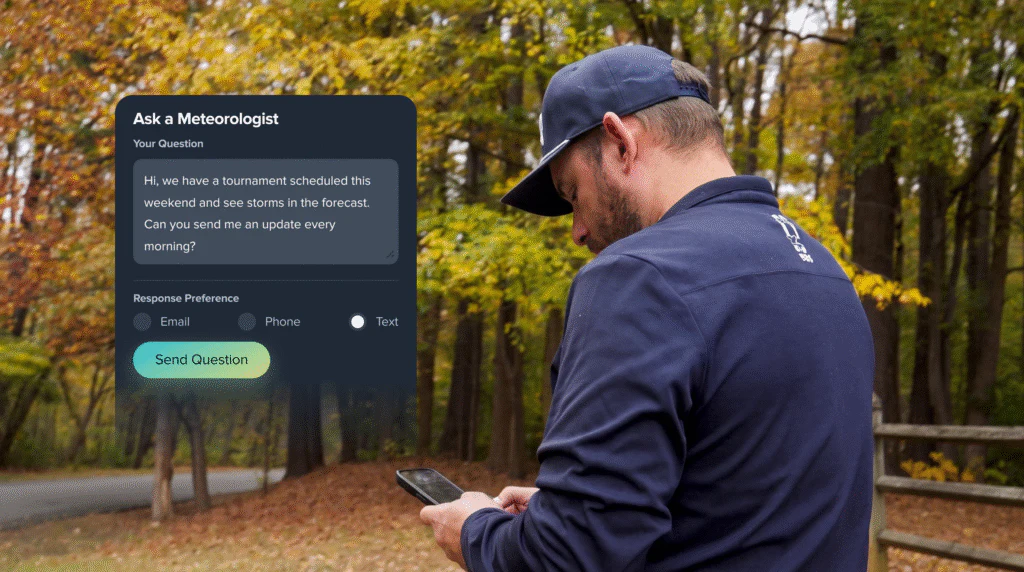
He used Perry Weather’s Ask a Meteorologist service to understand how quickly the system was moving and how much time the Tour had to act. And a Perry Weather meteorologist is there to answer any call, text or email.
“What are we looking at for a time frame?” Munsey recalls asking. “How fast is this coming in? What does it look like before we should call this?”
The DGPT closed the course and moved activities to another day to keep patrons, players and staff safe from continued lightning and tornado threats.
More information = more time to change the outcome
Not every weather decision ends with activities or suspending work.
At one tournament, Perry Weather showed elevated wet bulb globe temperature conditions. Instead of waiting for heat-related issues to develop, the Tour increased player check-ins, distributed water and electrolytes, and made additional supplies available to spectators and staff.
Munsey shared the forecast with local EMS before the heat peaked so responders could decide whether personnel or ambulances should be positioned closer to the event. The WBGT reading did not stop the round, rather it changed the support surrounding it.
The same was true when smoke from Canadian wildfires reached a tournament in Minnesota. Munsey used Perry Weather for air quality monitoring, tracking the AQI to understand what players and spectators would encounter on the course.
One Source of Truth for All
The Tour’s weather plan only works if changing conditions reach the people responsible for acting on them.
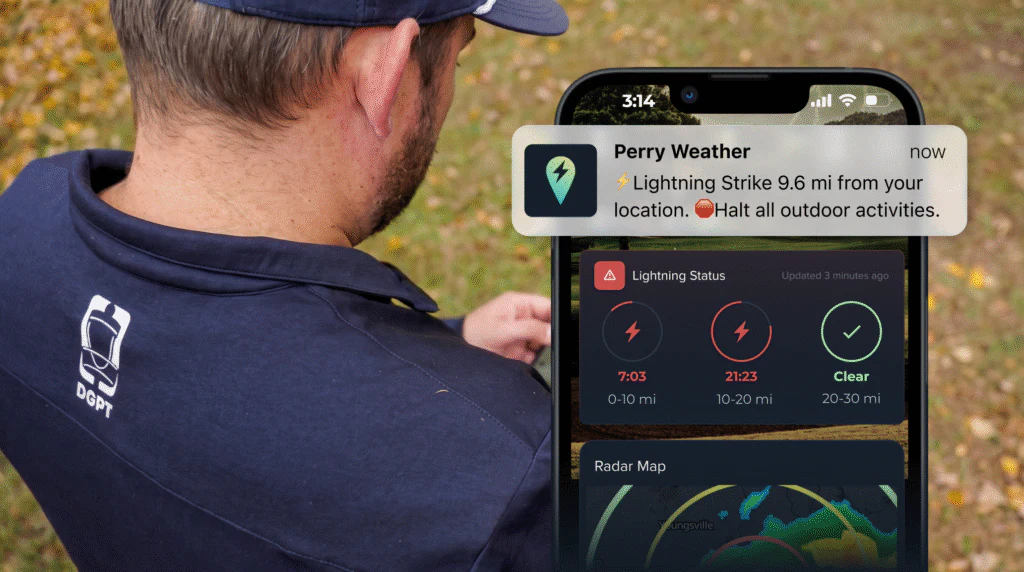
Event staff can access Perry Weather from their phones, while customizable notifications help route relevant alerts to the teams that need them. When lightning approaches, operations staff can prepare the horns used to suspend play, media teams can anticipate a broadcast interruption, and event leaders can begin coordinating the response from the same underlying information.
The Tour extends that visibility to spectators through Perry Weather’s public-facing widget. Shared before and during competition, it gives attendees access to the current forecast and lightning proximity from the same source informing the DGPT’s decisions.
“Using the Perry Weather platform to get an informed decision—not only on forecasting, but really nowcasting—is important for us,” Munsey said.
The Perry Weather standard that travels
The Disc Golf Pro Tour spent its first decade building the visible markers of a major sport: bigger crowds, stronger broadcasts, and a stage worthy of the best players in the world.
But raising the bar often lives in the decisions the crowd never sees.
For Munsey, that means bringing the same weather safety operations to every stop, even when the venue changes completely. Real-time radar, lightning alerts, customizable notifications, and direct access to meteorologists give each event a common operating language before the first disc is thrown.
“It raises the level of professionalism that we’re bringing to the sport,” he said.
Perry Weather gives a traveling Tour something its temporary venues cannot: continuity.
Try it free for 14 days
When a storm calls, your meteorologist picks up.
Whether you’re in Seattle or New York, Perry Weather’s 24/7 meteorologist team, lightning detection, and WBGT monitoring travel with your event. So you can make the right call before conditions make it for you.


