


On Wednesday, April 8th, current Alabama Governor Kay Ivey signed Alabama House Bill 381, the Sarah Marsh Heaven’s 27 Camp Safety Act. This bill aims to improve Alabama camp safety by establishing severe weather protocols and an emergency plan for camps – including fully operating with a NOAA weather radio, an alerting protocol for staff, and an audible alert system for campers.
Following in the footsteps of Texas’ Heaven’s 27 Camp Safety Act (SB1), Alabama HB381 honors eight-year-old Alabama camper Sarah Marsh, who died in the July 2025 flooding at Texas’ Camp Mystic. Below, we explain Alabama HB381, including who it is for, what it requires, and how it differs from existing camp safety legislation in surrounding states.
What is Alabama’s Sarah Marsh Heaven’s 27 Camp Safety Act?
Alabama’s Sarah Marsh Heaven’s 27 Camp Safety Act is a house bill sponsored by Rep. David Faulkner, meant to improve camp safety throughout Alabama. This action came as a result of the Camp Mystic tragedy and aims to establish safety standards at Alabama summer camps. Although similar, it is separate legislation from Texas’ similarly named Heaven’s 27 Camp Safety Act, signed by Governor Gregg Abbott on September 5, 2025.
Alabama Governor Ivey first signaled her commitment to camp safety in January 2026 during her State of the State address. In February 2026, the Alabama House passed HB381 by a unanimous 104-0 vote. The Senate soon followed.
The new Alabama law makes emergency preparedness a condition of operating a covered overnight camp in the state. Beginning in 2027, each camp will need a new emergency preparedness license from the Alabama Emergency Management Agency (AEMA).
New requirements for Alabama’s 2027 camp season
Alabama’s new House Bill 381, also known as the Sarah Marsh Heaven’s 27 Camp Safety Act, creates an emergency preparedness licensing system for covered overnight camps effective January 1, 2027. The bill sets requirements for camp emergency plans, communications, flood safety, staff screening, and training.
For the 2027 camp season, covered Alabama overnight camps must meet the following requirements under HB381:
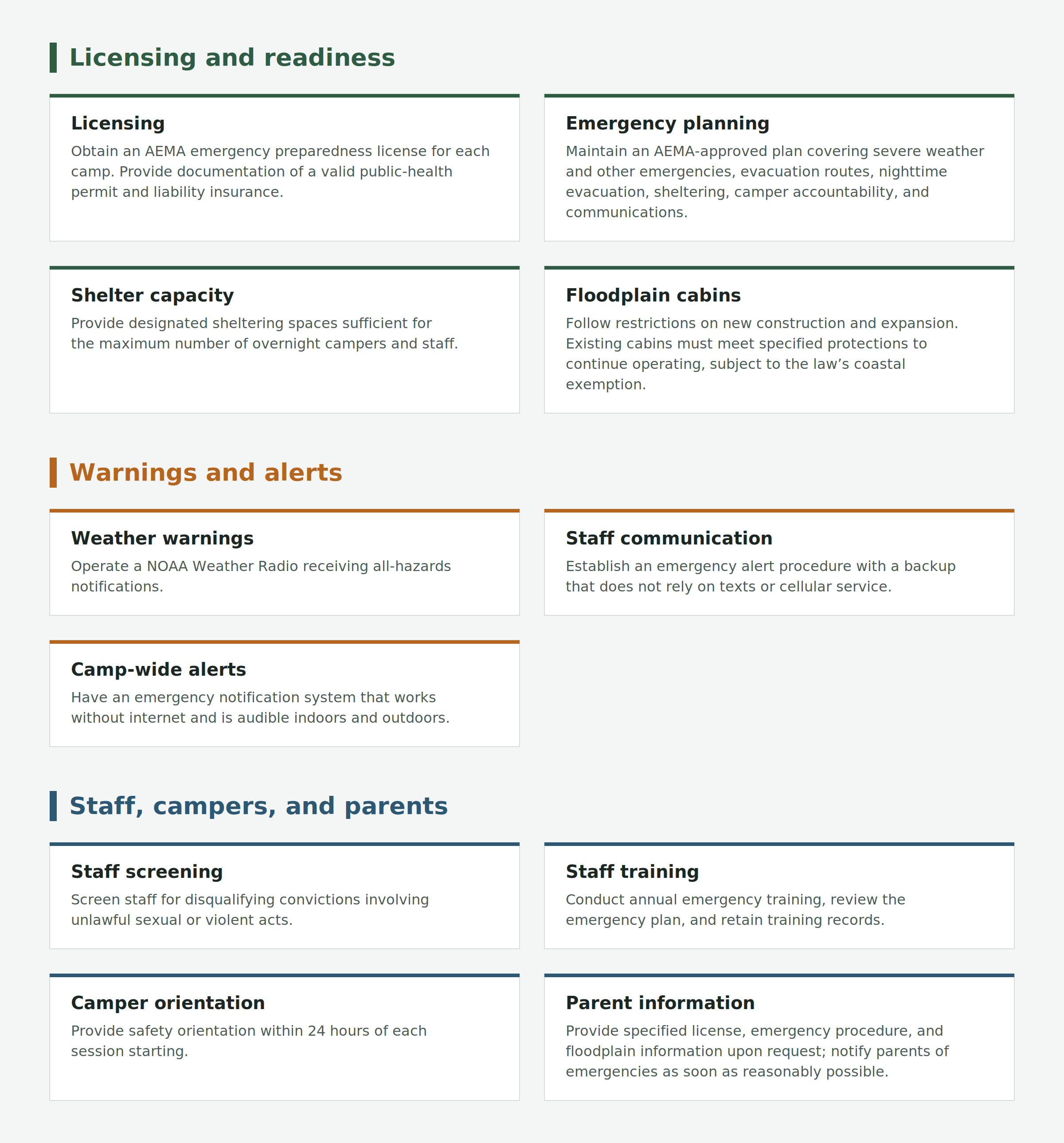
In addition, those operating a covered overnight camp in Alabama must now also obtain an emergency preparedness license from the Alabama Emergency Management Agency (AEMA) to remain in compliance with Sarah Marsh Heaven’s 27 Camp Safety Act.
Here’s how the process will work for camp operators:
The operator applies for each camp separately. The application must include an emergency plan for AEMA approval, a staff list, and documentation of a valid public-health permit and liability insurance.
The camp must meet the law’s safety standards. These include emergency communication equipment, adequate shelter capacity, applicable floodplain protections, staff screening, and emergency training. AEMA develops application forms and instructions for documenting compliance.
AEMA reviews the application. AEMA must notify the operator of approval or denial within 90 days of an initial application. If denied, AEMA must explain the deficiencies; the operator can appeal within 30 days.
The license generally lasts five years. Certain changes—such as altered camp boundaries, additional cabins, or renovations increasing a cabin’s capacity by more than three campers—require a supplemental application within 45 days.
Safety obligations continue between renewals. Staff training remains annual, and emergency plans must stay current. Plan updates made for reasons other than a required facility-change application must be submitted for approval within 10 days.
AEMA maintains oversight and public visibility. It publishes a list of licensed camps and may inspect required documentation, training records, and the on-site availability of approved safety plans.
Beginning January 1, 2027, covered Alabama overnight camps must obtain an emergency preparedness license and meet the law’s safety requirements before operating. The Youth Camp Safety Advisory council, made up of state agencies, emergency responders, camp organizations, and camp safety advocates, meets as needed to advise AEMA on implementing the camp safety law, both during preparation for January 2027 and afterward.
This council meets as needed and dissolves three years after its establishing section takes effect.
Which Alabama camps does HB381 apply to?
Alabama HB381 applies to covered overnight camps in Alabama serving campers age 16 or younger while they are away from their parents or guardians. This includes both for-profit and nonprofit camps that provide overnight sleeping structures.
Sarah Marsh Heaven’s 27 Camp Safety Act specifically excludes dedicated hunting or fishing locations or structures, as well as dormitories and residences at educational institutions.
How does Alabama’s new camp emergency preparedness license work?
Beginning January 1, 2027, covered Alabama overnight camps must obtain an emergency preparedness license from the Alabama Emergency Management Agency (AEMA) as a condition of operating. Operators managing multiple camps must obtain a separate license for each location.
Here’s how getting a license to remain compliant with Alabama HB381 works:
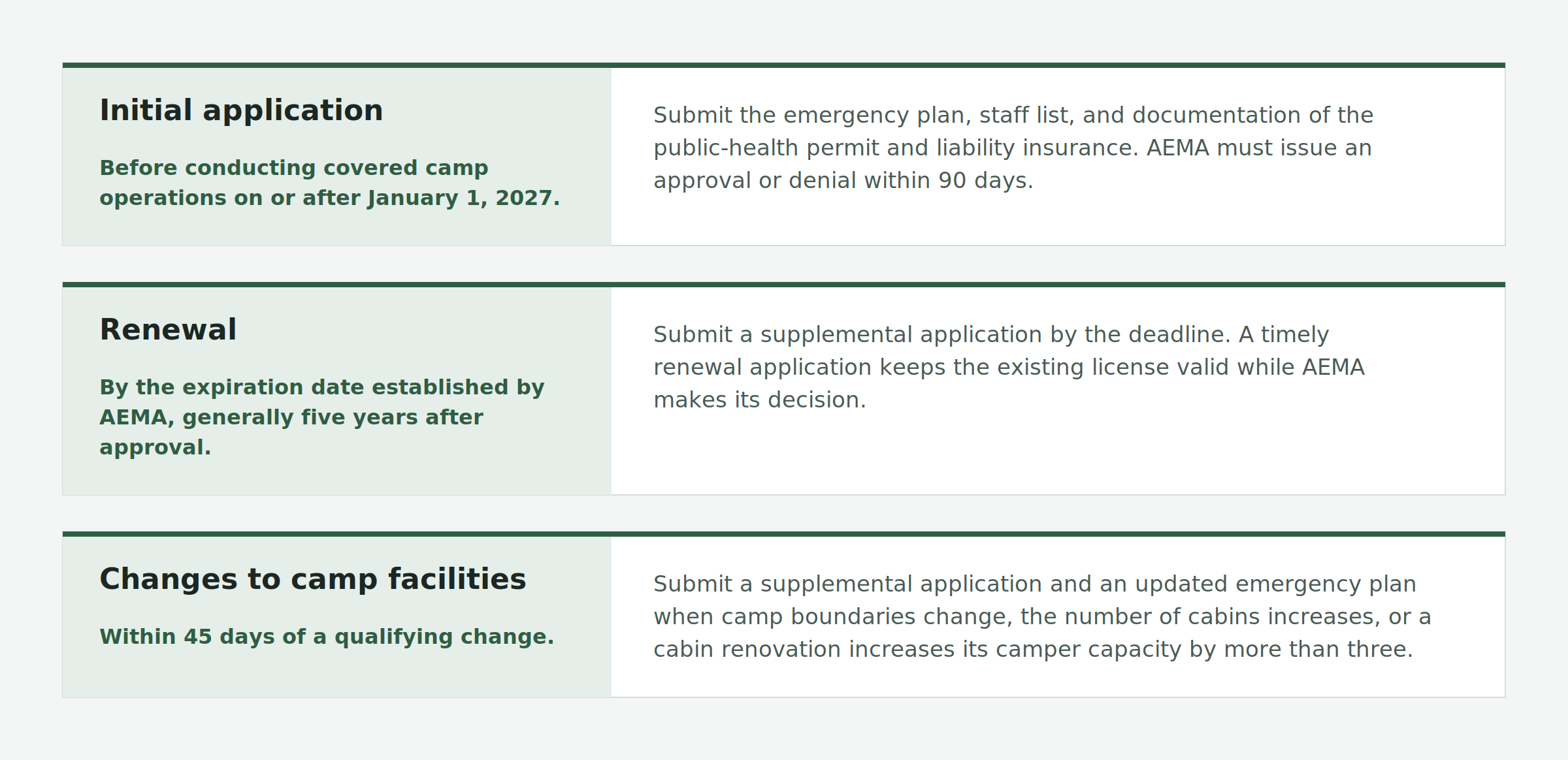
A license is generally valid for five years from approval, and reviews generally take 90 days. For camps preparing to open in summer 2027, operators should allow time for AEMA’s review and any corrections needed before camp operations begin.
Under HB381, camps are not required to resubmit materials unless their license is up for expiry, camp boundaries change, or camp and cabin capacity increase.
What weather monitoring and emergency notification systems are required?
As part of Sarah Marsh Heaven’s 27 Camp Safety Act, covered camps must have equipment and procedures for receiving emergency warnings, notifying essential staff, and audibly alerting campers throughout the property.
Receiving a warning with a NOAA Weather Radio
Alabama HB381 now requires camp operators to obtain and use a NOAA Weather Radio that receives all-hazards notifications. This provides a way to receive official emergency information and severe weather warnings without relying on an internet connection.
Perry Weather’s weather monitoring software helps staff track conditions through a dashboard and mobile app. An on-site weather station adds local measurements to help operators understand conditions where campers are spending time.
Notifying staff with an emergency alert protocol.
Alabama’s Sarah Marsh Heaven’s 27 Camp Safety Act requires overnight camps to establish a protocol for alerting essential staff during an emergency, including a redundant procedure that does not rely on text messaging or cellular service. Operators should identify who receives the initial warning, who notifies other staff, and what backup method they will use if their primary communication channel fails.
Perry Weather can send automated text and push notifications with instructions tied to a camp’s weather policies. These help staff know when to act and what to do. Camps must also maintain the independent backup communication procedure required by the law.
Alerting campers with audible notifications
The law also requires an emergency notification system that does not rely on an internet connection. It must also provide an alarm and emergency notification audible to staff and campers. Operators should determine if notifications can be heard throughout the property.
Perry Weather’s outdoor warning system supports sirens, strobes, and custom PA announcements for hazards including lightning, tornadoes, and flash floods. Messages can communicate specific instructions, helping people understand whether to seek shelter or follow an evacuation route.
What must Alabama camps include in their emergency plans?
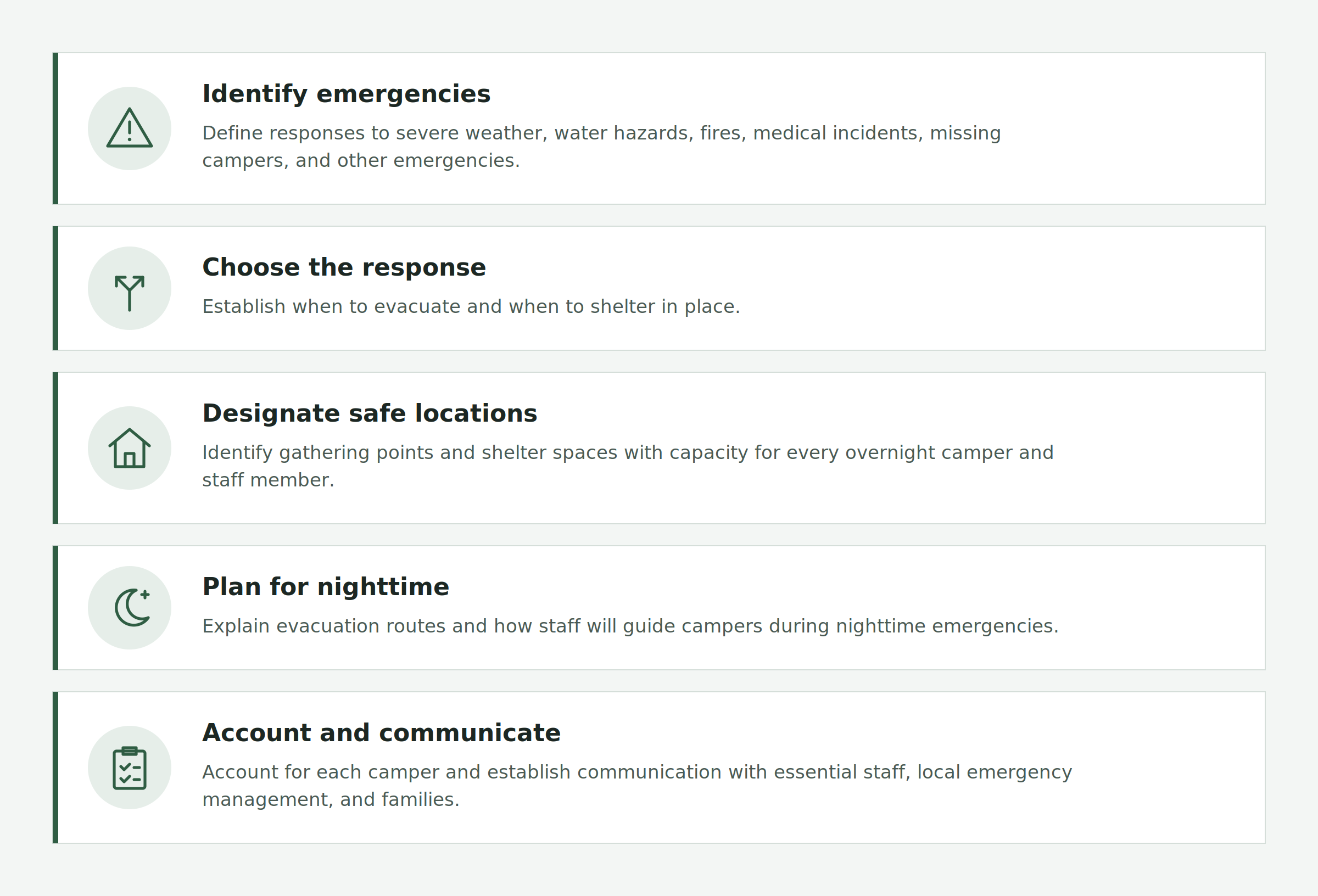
Your camp’s emergency plan should turn the new requirements of Alabama HB381 into clear procedures staff can follow, even at night. The plan should identify evacuation routes, gathering locations, shelter spaces sufficient for the maximum overnight population, and how staff will account for campers and communicate during an emergency. Below are the five essential pieces of any camp emergency plan to remain in compliance with Sarah Marsh Heaven’s 27 Camp Safety Act.
The bottom line: how to prepare your Alabama camp for 2027
Preparing for Alabama’s 2027 camp season means making sure your emergency plan, equipment, and staff preparation work together. Review your warning systems, confirm evacuation routes and shelter capacity, and allow time for AEMA to review your license application before camp operations begin.
FAQs
When does Alabama HB381 take effect?
The Sarah Marsh Heaven’s 27 Camp Safety Act takes effect January 1, 2027. Beginning on that date, covered overnight camps must obtain an AEMA emergency preparedness license and meet the law’s safety requirements as a condition of operating. Camps opening in summer 2027 should allow time for application review before their first session.
Which Alabama camps need an emergency preparedness license?
The law covers Alabama overnight camps serving campers age 16 or younger, away from their parents or legal guardians, that provide sleeping structures such as cabins, dormitories, or bunkhouses. It includes for-profit and nonprofit camps offering recreational, religious, social, educational, or therapeutic activities. Certain hunting and fishing facilities and the use of available residences at educational institutions are excluded.
Does HB381 apply to day camps?
Day-only camps fall outside HB381’s definition of camp operations, which requires overnight stays. Operators offering both day and overnight programs should evaluate whether their overnight operations meet the law’s definitions.
Can existing cabins remain in a floodplain?
Yes, if the operator demonstrates the required protections to AEMA. These include a lowest finished floor at least two feet above the applicable base flood elevation, appropriate high-water markers, a location outside a designated regulatory floodway, and enhanced flood evacuation procedures. Where a base flood elevation is unavailable, operators must obtain and use the best available flood data.
The law restricts new cabin construction and expansion in floodplains and provides a separate exemption for cabins at camps located in or contiguous to FEMA Zone V or VE coastal high-hazard areas.
What emergency notification equipment is required?
Covered camps must have a NOAA Weather Radio, an emergency alert protocol for essential staff with a backup independent of texts or cellular service, and an emergency notification system that works without internet and is audible indoors and outdoors. The law does not expressly mandate an on-site weather station or a particular lightning detection product.
Is Alabama’s law the same as Texas’s Heaven’s 27 Camp Safety Act?
No. Alabama’s Sarah Marsh Heaven’s 27 Camp Safety Act is separate legislation with its own requirements and an AEMA-administered licensing process. Alabama operators should follow HB381 rather than assume Texas requirements apply. For Texas-specific information, see our guide to Texas’s Heaven’s 27 Camp Safety Act.
What staff training and camper orientation are required?
Staff must complete annual training on the camp’s emergency procedures and review the current emergency plan at least annually and when AEMA approves an update. Operators must retain written or digital records of completed training.
Campers must receive a safety orientation within 24 hours of each session starting, covering camp boundaries, property hazards, and age-appropriate instructions for emergencies and evacuation.


