


As an athletic trainer or director, WBGT monitoring isn’t optional, it’s the foundation of your heat safety compliance. Many schools and organizations rely on the Kestrel 5400 because it’s portable, relatively inexpensive, and widely recognized. But multiple independent studies have raised serious concerns about its accuracy, particularly in the sunny, humid conditions where it matters most.
Nearly 40% of Kestrel readings would have restricted athletic activity unnecessarily
A University of Georgia study found that nearly 40% of the Kestrel readings would have resulted in restricting athletic activity when the ISO standard device showed that activities could safely continue.
Kestrel 5400 WBGT Accuracy Problems
Multiple independent studies show the Kestrel 5400 tends to read higher than actual WBGT, and that gap widens as conditions get hotter.
For example, at a WBGT of 86°F, about 75% of Kestrel 5400 readings are higher than the actual WBGT, and this disparity reaches nearly 100% at a WBGT of 92°F.
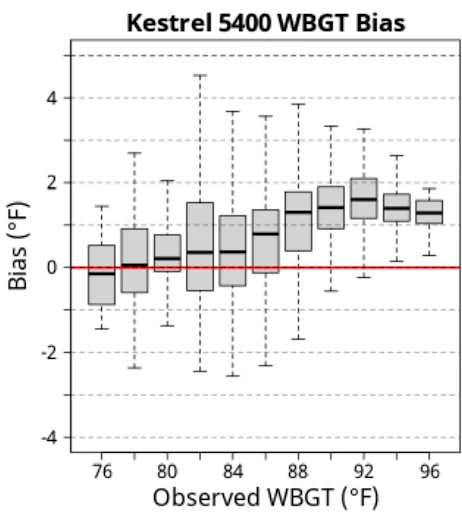
Multiple independent studies have found that nearly 40% of the Kestrel readings would have resulted in restricting athletic activity when the ISO standard device showed activities could safely continue.
Why Kestrel Reads High in Direct Sunlight
Three design limitations drive the Kestrel’s inaccuracy in field conditions:
1. No Solar Radiation Shield
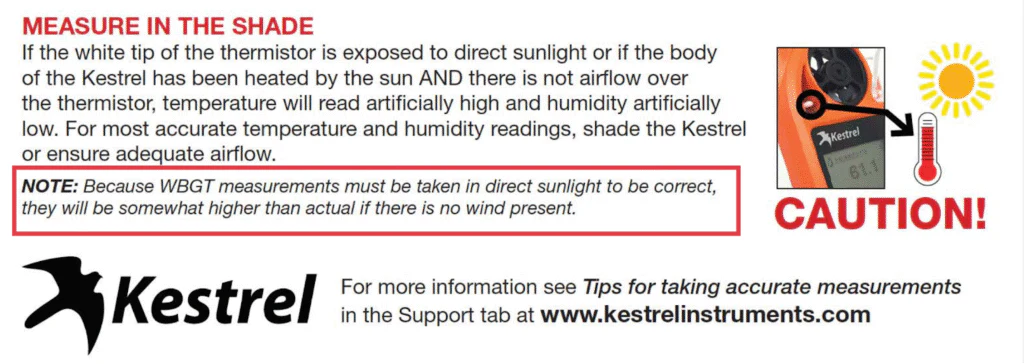
Temperature and humidity sensors are unshielded from direct sunlight. The device heats up, producing ambient temp readings that are higher than actual air temperature. Kestrel’s own documentation acknowledges this — it recommends measuring in the shade.
2. Undersized Black Globe
The Kestrel uses a small black bulb sensor. Smaller globes are more reactive to short-term changes like cloud cover, wind gusts, producing unstable readings that spike high. ISO-standard provide larger black globes that smooth out those fluctuations.
3. Wind Overcorrection
Small globes are disproportionately cooled by wind, which can paradoxically pull wet bulb calculations in conflicting directions, producing erratic outputs in breezy conditions.
4. Device Self-Heating
The Kestrel’s internal electronics generate heat that can affect onboard sensor readings when the unit is held or set in direct sun, a compounding source of error on hot days.
High School State Mandate Compliance Risk
Many states and governing bodies require athletic programs to monitor and document WBGT at defined intervals during practices and games. If your Kestrel is systematically overestimating WBGT, you face two problems:
- Unnecessary activity restrictions: disrupting training schedules, acclimatization plans, and game-day operations
- Faulty documentation: recorded WBGT readings that don’t reflect actual environmental conditions, creating liability exposure
Click here to see all State governing bodies with WBGT monitoring mandates.
Why Kestrels Are Impractical for Daily Compliance
Beyond accuracy, the handheld workflow itself creates operational problems for ATs managing busy practice environments.
- 10–20 Minute Sensor Equilibration
Handheld devices need time to stabilize before readings are reliable. Set one down 5 minutes before a 3 PM practice and your first reading is garbage. - Requires Precise Positioning Every Time
Height, orientation, shade vs. sun — every variable affects results. Consistent positioning across staff members and sessions is nearly impossible to enforce. - No Automated Alerts to Coaches or Staff
When WBGT crosses a threshold, you’re the one calling every coach. Kestrel can’t push policy-based instructions to the people who need them simultaneously. - Data Stuck on One Device
Most handhelds lack automated logging and report exports. Compliance documentation becomes a manual process, and institutional knowledge lives with whoever holds the device.
What to Look for in a WBGT Device
Not all WBGT monitors share the same limitations. When evaluating alternatives, these are the specifications that matter for field accuracy:
- Larger black bulb: greater thermal mass means more stable, representative radiant heat readings that don’t spike with passing clouds or gusts.
- Aspirated radiation shield: actively moves air across the temperature sensor to prevent solar heating of the sensor body itself
- Continuous monitoring: permanently installed devices eliminate equilibration time and positioning error entirely.
- Automated logging: look for devices that record timestamped readings automatically, so compliance documentation doesn’t require manual effort.
The Kestrel 5400 meets none of these criteria. That’s not a knock on its utility as a general weather instrument, it’s simply not engineered to the standard that heat stress policy compliance requires.
See a full side-by-side comparison of handheld Kestrels vs. on-site WBGT monitoring →


